

Basin Reserve History: New Zealand's Oldest Test Ground
By CricketTaken EditorialPublished Cricket in New Zealand14 min read
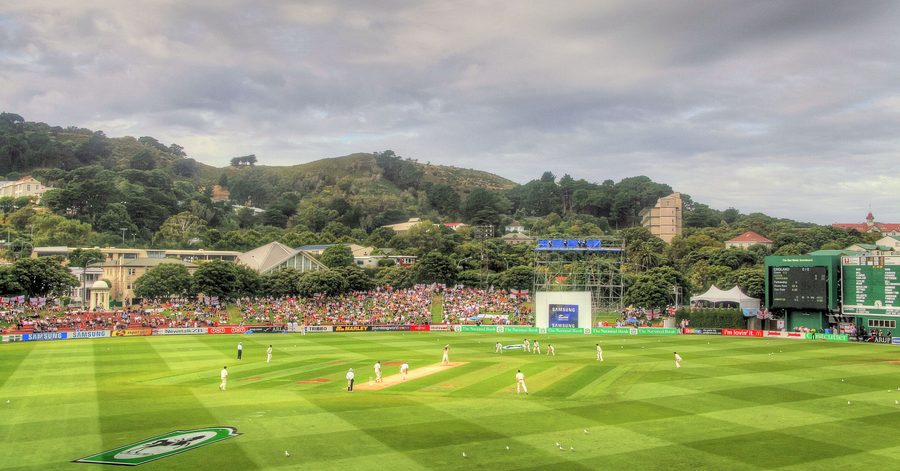
Every Test ground has an origin story, and most of them are dull: a club bought some land, a council leased a park, a stadium was built for a different sport and cricket moved in later. The Basin Reserve in Wellington has the only one that begins with the largest earthquake in New Zealand's recorded history. The ground exists because the sea floor moved. Everything peculiar about the place — the ring road around it, the mismatched stands, the wind that decides Test matches, the heritage certificate that saved it from a motorway flyover — descends from that single geological accident of January 1855.
It is the oldest cricket ground in New Zealand still hosting the international game, and by a distance the most argued-over. Wellingtonians treat it as civic property in a way that is unusual for a sports ground anywhere, which is why the guide below spends as much time on planning hearings and heritage law as on batting records. Both are the same story: a piece of ground that was never supposed to be a cricket ground has spent 160 years refusing to be anything else.
Before the earthquake: a harbour that never was
The New Zealand Company laid out Wellington in 1840 around a plan that made sense on paper and almost none on the ground. Te Aro, the flat land at the head of the harbour, was to be the commercial centre, and a short distance inland lay a shallow lagoon fed by the Waitangi stream. The surveyors marked it on the town plan as a basin — an inner harbour where small craft could tie up, connected to the sea by a canal cut through the intervening land. Hence the name, which has now outlived the idea by nearly two centuries.
The canal was never dug. It was expensive, the lagoon was shallow and swampy, and Wellington's early decades were consumed by more urgent problems than boat parking. The area sat as a wet, reedy hollow on the edge of the growing town, useful to nobody and periodically discussed as a nuisance. In the standard telling this is where the settler ambition quietly ran out of money, which was the fate of a great many New Zealand Company plans.
The 1855 earthquake
On the evening of 23 January 1855 the Wairarapa Fault ruptured. The earthquake is estimated at magnitude 8.2 and remains the most powerful ever recorded in New Zealand; it was felt the length of the country and reshaped the coastline around Wellington permanently. Land on the harbour's western side was thrust upward — by well over a metre in the city, considerably more at the fault itself — and the shoreline moved outward, creating the flat shelf that later carried Wellington's Hutt Road and much of its early expansion.
The lagoon went with it. Lifted clear of the water table, the basin drained into a swampy depression that would never again hold a boat. The canal scheme, already dormant, was now physically impossible. What the town had instead was several acres of awkward, damp, low-lying land in an increasingly built-up area, and no obvious use for it.
The answer arrived through the 1850s and 1860s in the least glamorous way imaginable: drainage, fill and manual labour, much of it provided by prison gangs, gradually turning the hollow into a level field. A public meeting resolved that the land should be kept as a recreation ground rather than sold for building — an unusually far-sighted decision in a young colonial town short of flat land — and by the late 1860s cricket was being played on it. That decision to reserve rather than subdivide is the reason there is an open green space in the middle of a New Zealand city at all, and it is why the ground's defenders have always been able to argue from something stronger than sentiment.
The ground takes shape
Wellington cricket adopted the new ground immediately and never left. The Basin became the home of the provincial side as inter-provincial cricket formalised through the 1870s, hosting the fixtures against Auckland, Canterbury and Otago that were the country's senior cricket long before New Zealand played anyone internationally. The early history of that provincial game, and how it became a national competition, is set out in the Plunket Shield guide; the Basin has been one of its principal venues from the beginning.
Touring sides came too. English and Australian teams passing through the colony played at the Basin from the nineteenth century onwards, in the era when a tour meant a long boat journey and a fixture list of provincial matches with no Tests at the end of it. The ground acquired the furniture of a serious venue in stages: a playing surface levelled and re-levelled, a pavilion, terracing, and the plane trees and pōhutukawa that still frame it.
The oldest building on site is the wooden stand dating from the 1920s that now houses the New Zealand Cricket Museum, a small and genuinely good collection of the country's cricket history kept inside the ground it documents. It is a rare arrangement — a national sporting museum sitting in a working Test venue's stand — and it says something about how the Basin has always been treated as an archive as much as a stadium.
1930: the first Test
New Zealand became a Test nation in January 1930, when an England side toured and played four Tests. The first was at Lancaster Park in Christchurch. The second, beginning on 24 January 1930, was at the Basin Reserve — and it turned a provincial ground into a Test ground for good.
The match was drawn, and it produced the innings that anchored New Zealand's early Test self-image. Stewie Dempster and Jackie Mills, opening the batting, put on 276 together, Dempster making 136 and Mills 117 on debut. It was the first century partnership of New Zealand's Test history and it went straight past everything the young side might reasonably have hoped for; the stand survived as the country's record for a first wicket for decades afterwards, through generations of openers who never got near it.
Two details about that Test are worth holding onto. The first is how quickly it settled the question of whether New Zealand belonged: the answer, in the first week, was that its best batters could bat. The second is that England's touring party was a second-string side, because a stronger England team was simultaneously playing the West Indies — a fact New Zealand historians record honestly and which does nothing to diminish what Dempster and Mills did. The full arc of the country's rise from that tour to a World Test Championship title is traced in the history of New Zealand cricket, and the deeper colonial beginnings in the origin of cricket in New Zealand.
Forty-eight years to a win
What followed was the long apprenticeship. New Zealand did not win a Test match at all until 1956, and did not beat England until February 1978 — a wait of forty-eight years and forty-eight Tests against the same opponent, ended at the Basin Reserve.
That match is the ground's defining occasion. New Zealand made 228 and 123, totals that ought to lose a Test, and England were bowled out for 64 chasing 137, Richard Hadlee taking six for 26 in a spell that turned a national inferiority complex over in an afternoon. It was won on a used surface with a low, uneven bounce, in front of a crowd that had been raised on defeat and did not entirely believe what it was watching. Every subsequent generation of New Zealand cricket dates its confidence from that week.
The Basin has kept adding entries since. It staged the Test in February 2014 in which Brendon McCullum batted through the better part of three days to make 302 and save a match New Zealand had followed on in; that innings is covered in the New Zealand cricket grounds guide along with the ground's pitch behaviour. It has hosted Kane Williamson at his most immovable, and been a home ground for the seam attack of Tim Southee and Trent Boult through the era that carried New Zealand to the 2019-2021 World Test Championship title. It has hosted women's international cricket, including World Cup fixtures during the 2022 tournament New Zealand staged at home; that history is told in the White Ferns story.
The R A Vance Stand
For most of its life the Basin's spectator accommodation was terraces, banks and wooden structures added piecemeal. The one substantial modern building on the ground is the R A Vance Stand, opened in 1980 on the western side, a two-tier concrete stand with the press box, corporate facilities and the ground's main covered seating.
It is named for Bob Vance, a Wellington cricket administrator whose service to the game ran through the provincial association and into national administration; his son Robert Vance played Test cricket for New Zealand, one of the small number of families with that particular double entry in the record. Naming the main stand after an administrator rather than a player is an unusually New Zealand decision, and an honest one — the Basin survived the twentieth century because people did committee work, not because anyone scored runs.
Architecturally the stand is not loved. It is a product of its decade, plainly larger than the ground around it, and it interrupts the Basin's otherwise low, open profile in a way that photographs badly from the bank opposite. Practically it is indispensable: it holds the facilities that international cricket requires, and without it the ground would have failed the standards for hosting Tests long ago. Its awkwardness is the compromise that has kept the rest of the Basin as it is.
| Element | Approximate era | Note |
|---|---|---|
| The reserved ground | 1850s-1860s | Drained and levelled after the earthquake |
| Museum stand | 1920s | Wooden; now houses the New Zealand Cricket Museum |
| Embankment and terraces | Twentieth century, in stages | Grass banking still the main seating |
| R A Vance Stand | 1980 | Main covered stand, press and corporate facilities |
| Heritage registration | 1990s | Category 1 historic place |
The rest is grass bank, temporary seating for big matches, a scoreboard, and the sightscreens. Capacity for a Test is in the low tens of thousands with temporary stands and a good deal less without them, which makes the Basin one of the smallest grounds on the world Test circuit — and, on a full day against Australia, one of the loudest for its size. The wider comparison with New Zealand's other international venues, and what watching cricket at each of them costs and involves, is covered in how to watch cricket in New Zealand.
The wind
Wellington sits at the mouth of Cook Strait, where the pressure difference between the Tasman Sea and the Pacific funnels air through a gap in the mountains. The city averages gale-force gusts on dozens of days a year, and the Basin Reserve is an open bowl with nothing upwind of it. No account of the ground is complete without this, because at the Basin the wind is a playing condition in the way that the pitch is.
Its practical effects are specific. Captains choose ends by wind direction before they think about anything else: a seamer running in with the northerly behind him gains pace and loses movement, while the same bowler working into it loses a couple of kilometres an hour and can swing the ball late and heavily. Bowling into the Wellington wind for a long spell is one of the hardest jobs in New Zealand domestic cricket, and it is also the best available training in wrist position — the physics of why New Zealand conditions reward that skill are set out in the guide to New Zealand swing bowling.
For batters the wind shortens one boundary and lengthens the other, sometimes by a considerable margin, so scoring areas differ by end. Skied catches drift several metres in the air and fielders learn to run at where the ball will be rather than where it looks like going. Bails come off in the breeze often enough that heavy bails are standard. Wind has occasionally been severe enough to stop play outright at the Basin, which is a rarity in world cricket and reliably surprises visiting sides.
The knock-on effect is cultural. Wellington cricketers grow up regarding the wind as an asset to be used rather than an obstacle, and the province has produced a long line of bowlers who can hold an end into it and batters who play late and low. Whether that shows up in the trans-Tasman fixtures against sides raised on flat, still Australian surfaces is a question taken up in the guide to the rivalry with Australia.
Heritage listing, and the flyover that never happened
The Basin Reserve is registered by Heritage New Zealand Pouhere Taonga as a Category 1 historic place, the highest classification available, covering the ground as a whole rather than any single structure. It is the only cricket ground in the country with that status. The registration recognises the site's continuous use for cricket since the 1860s, its origin in the 1855 uplift, and its place in Wellington's civic layout — a rare surviving example of a colonial recreation reserve still doing the job it was reserved for.
That listing became load-bearing in the 2010s. The Basin sits inside one of Wellington's worst traffic bottlenecks, and the transport agency proposed a two-lane flyover carrying state highway traffic over the northern corner of the ground. The case was economic and, on its own terms, reasonable. The opposition was heritage, amenity and civic identity, argued at length before a Board of Inquiry, which in 2014 declined consent on the grounds that the adverse effects on the Basin Reserve's heritage and landscape values outweighed the transport benefits. The decision was challenged and upheld by the High Court the following year, and the flyover was abandoned.
It is worth being clear about what that episode demonstrated, because it is unusual. Grounds elsewhere in the world have been redeveloped, relocated or lost to infrastructure with far less resistance. The Basin survived because its heritage status converted an emotional argument into a legal one, and because Wellington produced enough organised public opposition to sustain a multi-year statutory process. Heritage listing did not simply commemorate the ground; it defended it.
The listing carries obligations in the other direction too. Alterations are constrained, upgrades to facilities have to be negotiated against heritage values, and the ground cannot be modernised the way a greenfield stadium can. That tension — an international venue that has to meet contemporary broadcast, security and hospitality standards inside a protected historic site — is the Basin's permanent management problem, and it is handled by a trust structure with the city council and the cricket association both involved. The governance of New Zealand cricket's venues and associations more broadly is set out in the guide to how New Zealand Cricket is structured.
A working ground, not a monument
The temptation with a heritage-listed venue is to treat it as a museum piece that occasionally hosts a Test. The Basin is the opposite: it is one of the busiest cricket grounds in the country, in use most days of the summer. It is Wellington's home for first-class and one-day domestic cricket, hosting the province's fixtures in the Ford Trophy and its four-day programme; it stages school finals, representative age-group matches, women's domestic cricket and club finals; and its outfield is walked across by commuters and eaten lunch on by office workers for most of the year.
That density of use is the argument the heritage documents cannot quite capture. The ground's significance is not that something historic happened there in 1930 or 1978 — it is that cricket has been played there continuously, at every level from schoolboy to Test, for more than a century and a half, on the same square, in the same wind. Very few grounds anywhere can say that, and none of the others in New Zealand can.
Visiting
The Basin is a fifteen-minute walk from Wellington's railway station and closer than that to the centre of town, which makes it one of the most accessible Test grounds anywhere; a road runs entirely around it, so the walk in is across a pedestrian crossing rather than through a car park. Domestic cricket is free to attend and lightly attended, and a weekday four-day match at the Basin — a couple of hundred people on the bank, the museum open behind them, a southerly coming through — is one of the better cheap afternoons in New Zealand sport.
Test tickets sell in numbers the ground can absorb, and the bank remains the place to sit, with a rug and something windproof regardless of the forecast. The wider practical detail on seasons, ticketing and broadcast for every venue in the country sits in the cricket in New Zealand hub, and the domestic T20 competition's use of Wellington grounds is covered in the Super Smash guide. Career records for the players named above are in the players database.
Sources and method
This guide draws on the published record of Wellington's colonial settlement and the 1855 Wairarapa earthquake, Heritage New Zealand Pouhere Taonga's registration of the Basin Reserve as a Category 1 historic place, the public record of the Basin Bridge Board of Inquiry decision and the subsequent High Court judgment, and the standard scorecard record of Test matches played at the ground. Dates for the ground's early development are given as decades rather than exact years, because the drainage and levelling work ran over a long period and the contemporary records are incomplete. Capacity figures vary with temporary seating and are described as ranges. CricketTaken is an independent publication with no affiliation to New Zealand Cricket, the Wellington Cricket Association, the Basin Reserve Trust or Heritage New Zealand.