

Club Cricket in Dubai: Leagues, Tape-Ball and the ICC Academy
By CricketTaken EditorialPublished Cricket in the United Arab Emirates10 min read
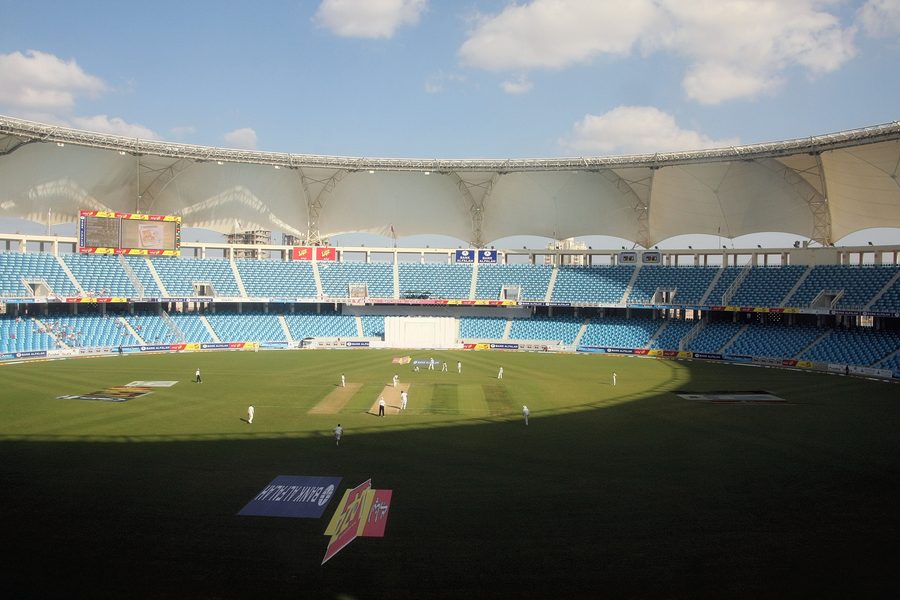
On any Friday morning between October and April, Dubai stages more organised cricket than most Test-hosting cities manage in a month. Matches begin at daybreak on the ICC Academy's ovals, on school grounds rented for the weekend, on club venues scattered from Jebel Ali to Al Awir; by mid-afternoon the second shift has taken over; and long after dark the floodlit tape-ball leagues start their fixtures on car parks and caged pitches across the city, running towards midnight. Almost none of it appears in any newspaper. All of it is the actual cricket life of a city better known for the stadium fixtures it hosts.
This guide is a map of that scene: the weekend hard-ball leagues and how their divisions work, the corporate cricket economy, the tape-ball night game, the ICC Academy's role as the scene's unofficial capital, what playing here costs, and how a newcomer actually gets a game. It is a city-level companion to the country-wide picture in the guide to the UAE's domestic cricket system; where that page explains the national architecture, this one describes what a Dubai club cricketer's season looks like from inside it.
Why Dubai's club scene is the shape it is
Three facts set the scene's character before a ball is bowled. First, the players: Dubai's cricket population is overwhelmingly expatriate — Indian, Pakistani, Sri Lankan, Bangladeshi, Nepali, Afghan, with a seasoning of British, Australian and South African players — and almost everyone arrived with their game already formed. A Dubai club is not a village institution raising cricketers from the age of seven; it is an assembly point for adults who learned elsewhere.
Second, the land: Dubai has no commons. Every proper ground is owned — by a school, an academy, a developer, a government body — and hired by the hour, which makes ground fees the tax on the entire scene and explains most of its economics. Third, the calendar: the season is the winter, roughly October to April, because summer cricket in forty-five-degree heat is possible only at night or indoors. The result is a compressed season of extraordinary density, in a city where the same weekend can offer a division-one club final, six corporate fixtures and a hundred tape-ball matches.
Dubai's scene is also, by UAE standards, the young sibling. The country's oldest club tradition belongs to Sharjah, whose Bukhatir League predates Dubai's modern leagues by decades and whose story is bound up with the neutral-venue era that made the Emirates famous; plenty of Dubai-based players still travel up the road to play Sharjah competitions. What Dubai added, as the city boomed, was scale and money: more teams, more grounds, more sponsors, and the game's global administrators living in a business park off Sheikh Zayed Road.
The weekend hard-ball leagues
The scene's formal spine is weekend limited-overs cricket, sanctioned through the emirate's cricket council under the umbrella of the Emirates Cricket Board's structure. The pattern is stable even as league names and sponsors rotate: multi-division competitions, mostly in formats from twenty to forty overs, played on Saturdays and Sundays through the winter, with promotion and relegation between divisions and a knockout or two laid across the league season.
The clubs themselves are unlike English or Australian clubs in one defining way: very few own anything. A typical Dubai club is a captain-organiser, a WhatsApp group, a sponsor covering part of the season's costs, a kit design and a booking relationship with a ground — an organisation of pure software. Some are community institutions decades old with genuine identity and juniors' sections; some are academies fielding senior teams; some are effectively one strong benefactor's XI, and dissolve when he changes jobs or emirates. Squad turnover tracks the city's visa churn: every season, every club loses players to repatriation and gains new arrivals, and a side that wins the top division can be unrecognisable two years later.
The standard at the top is serious. Division-one Dubai cricket includes former first-class players from the subcontinent, current and former UAE internationals keeping sharp between national windows, and ambitious young professionals — and because the pool of proper turf grounds is small, the leading matches are played on surfaces of a quality most amateur cricketers never see. The lower divisions grade down through good club standard to genuinely social cricket, which is the scene's quiet virtue: there is a division for almost any adult who can hold a bat.
Corporate cricket, the parallel economy
Alongside the open clubs runs a second complete league system: corporate cricket, in which the teams are companies. Banks, airlines, construction groups, hospitals, logistics firms — Dubai's employers field sides in dedicated corporate tournaments and leagues, usually in short formats under lights on weekday evenings, and for thousands of players this is their entire cricket.
The corporate game matters more than its social image suggests, for two reasons. Economically, it subsidises the infrastructure: corporate tournaments pay full commercial rates for grounds, lights and umpires, and that revenue keeps venues viable for everyone else. And competitively, the top corporate sides are strong — companies recruit with cricket quietly in mind, a practice with deep subcontinental roots, and a bank's team in a premier corporate tournament may contain more former professionals than a mid-table open club. The line between "corporate social cricket" and "semi-professional cricket with a payroll attached" is, in a handful of famous cases, decorative.
For a working newcomer, corporate cricket is also the easiest door in the city: if your employer fields a team, you have a net session and a fixture list without navigating the club scene at all.
Tape-ball nights
Beneath and around all the hard-ball structures runs the biggest game in the city by sheer participation: tape-ball cricket, played at night, on any flat lit surface — dedicated caged courts, car parks, industrial-area lots, compound courtyards. A tennis ball wrapped in electrical tape, short boilerplate formats of five to ten overs, and organised competition ranging from ad-hoc challenge matches to sponsored night leagues with entry fees, trophies, streamed finals and followings that dwarf the formal leagues'.
This is Pakistan's street game transplanted whole — the format's origins, techniques and shadow-professional culture are the subject of the site's guide to tape-ball cricket — and in Dubai it serves the population the formal scene structurally excludes: men whose working hours, wages or transport rule out weekend turf cricket but who can play brilliant, fast, serious cricket at ten o'clock at night for the cost of a shared court hire. The standard at the top of the night leagues is startling; the skills are the tape-ball specialist's skills, all wrist and improvisation and yorkers; and the crossover with the hard-ball scene is thinner than romance suggests, because the two games select for different techniques and different lives. Ramadan is the night game's high season, when tournaments multiply and matches run between iftar and suhoor — the one time of year when the city's cricket calendar is fullest after midnight.
The ICC Academy and Dubai Sports City
Every scene has a capital, and Dubai club cricket's is the ICC Academy at Dubai Sports City. The global governing body moved its headquarters from London to Dubai in 2005, and the academy grew up alongside it as the ICC's high-performance training base: full-size ovals, banks of turf and artificial nets, indoor facilities, professional coaching and international-standard groundskeeping, all embedded in a residential sports district rather than fenced off for the elite.
Its double life is what makes it matter here. On a given day the ovals might host an international side's training camp, an Under-19 fixture, and — this is the point — round after round of ordinary club and corporate league cricket, because the academy hires its facilities commercially and the club scene is its steady customer. Dubai club cricketers routinely play league matches on grounds prepared to the standard of the international venues described in the UAE grounds guide, a facilities inheritance no other city's amateurs enjoy. The academy is also the scene's coaching hub — its programmes run from junior development to serious adult coaching — and its nets on a winter evening, every lane booked, half the city's teams preparing at once, are the single best place to see the breadth of Dubai cricket in one look.
Around it, Dubai Sports City's other grounds and the emirate's stock of school and academy venues complete the map. The international stadium up the road belongs to a different economy — the hosting economy of tours, leagues and Pakistan's exiled home fixtures — but its presence shapes ambition: a Dubai club cricketer trains a taxi ride from grounds that stage World Cup matches.
What it costs, and how the money works
Club cricket in Dubai runs on match fees, and honesty about the economics helps a newcomer budget. Because grounds are hired commercially, a hard-ball league fixture carries real costs — ground and lights, match balls, umpires, league affiliation — which clubs cover through a mix of sponsorship and per-match player fees. A season in a weekend league therefore costs a playing member something closer to a gym membership than the nominal subs of an English village club, with corporate sponsorship the difference between a cheap season and an expensive one. Tape-ball splits a court hire between a dozen players and costs almost nothing, which is precisely why it is the mass game.
The flip side of the expense is quality of service: paid grounds come with prepared pitches, working lights and someone accountable for both, and the scene's better leagues are efficiently run because their customers are paying. Kit and equipment are cheap and abundant — Dubai's sports retail serves the whole Gulf's cricket population — and coaching, from academy lanes to private specialists, is a competitive open market.
How to actually get a game
The practical part, because it is the question every arriving cricketer asks. The routes, in rough order of ease: an employer's corporate side, if one exists, is the shortest path. Failing that, the open clubs recruit constantly — turnover guarantees it — and the standard mechanism is the trial net: leagues and clubs advertise through community networks and social media, and a newcomer who turns up to a club's net session with evidence of a game will generally be placed at an appropriate level quickly, because organisers know the divisions well enough to slot players accurately. Academies are a third door, fielding adult teams and running social leagues of their own, useful for players who want coaching bundled with cricket. And the night leagues need no introduction beyond a colleague who already plays in one.
Two pieces of local knowledge smooth the entry. The season's shape matters: recruitment concentrates in September and October as squads form, and a January arrival may wait for the odd mid-season vacancy. And the scene runs on its organisers — the captain-managers who book grounds, collect fees and hold clubs together are the system's load-bearing figures, and a reliable newcomer who pays promptly and fields willingly will find doors opening at speed.
Where Dubai club cricket leads
For most of its players, nowhere, gloriously: the scene's purpose is the game itself, and its densest divisions are full of forty-year-olds with no ambitions beyond Friday. But the pathway upward exists and is worth stating. Strong league performances feed the emirate's representative squads for the board's short-format development tournaments; those tournaments are watched by national selectors assembling squads whose evolution is traced in the UAE national team's history; and the top of the ladder now includes professional employment that did not exist a generation ago — central contracts, and the guaranteed local places in every International League T20 XI. A handful of current UAE internationals were, quite recently, Dubai weekend league cricketers with day jobs. The ladder is narrow and the odds are long, but unlike in most cricket cities, the man taking a five-for on a rented school ground on Saturday is genuinely visible to the people who pick national squads.
The wider context for all of it — how the emirate councils, the board and the franchise economy fit together, and what the system still lacks — is collected on the cricket in the UAE hub.
Sources and method
This guide is based on the publicly documented structure of Dubai's sanctioned weekend and corporate leagues under the emirate's cricket authorities, the ICC's 2005 relocation of its headquarters to Dubai and the published role and facilities of the ICC Academy at Dubai Sports City, the long-documented tape-ball culture of the UAE's South Asian communities, and the well-established economics of commercial ground hire in the emirate. League and sponsor names rotate frequently and are deliberately described as patterns rather than a directory; costs are characterised in comparative terms rather than figures that would date. Nothing here relies on unverifiable anecdote.