

Minor League Cricket: Structure, Teams and the MLC Pathway
By CricketTaken EditorialPublished Cricket in the United States11 min read
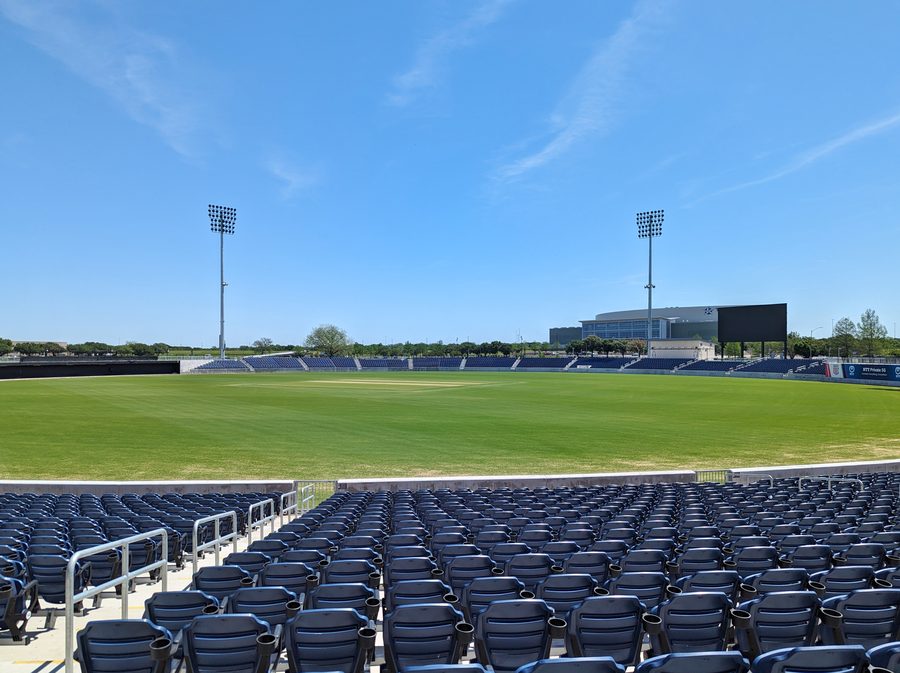
American cricket had a missing rung for a hundred years. At the bottom sat club cricket — thousands of weekend players in regional leagues, invisible to almost everyone. At the top, eventually, sat Major League Cricket, a franchise competition importing international stars. Between the two there was nothing: no place where a good club cricketer could be seen, measured against others like him, and moved upward. A scout looking for the best domestic players in a country of 330 million people had no schedule to consult.
Minor League Cricket is the rung that was built to fill that gap. It is a semi-professional Twenty20 league, launched in 2021, with city-based teams spread across the country, organized by the same group that built MLC. It is not glamorous. Matches happen on weekends at club grounds, most players earn little or nothing, and attendance is measured in hundreds. It is also, by a wide margin, the most important development the American domestic game has had in the modern era, because it turned an invisible player pool into a visible one.
What Minor League Cricket is
Minor League Cricket — MiLC in common shorthand — is a national T20 competition sanctioned by USA Cricket, the sport's governing body, and operated by American Cricket Enterprises, the entity that also runs Major League Cricket. That shared parentage is the single most important fact about the league: MiLC was designed from the start as MLC's talent base, not as an independent business that later found a purpose.
The league had a false start that was nobody's fault — a planned 2020 launch reduced to exhibition matches by the pandemic — and began fully in 2021 with more than two dozen teams, which made it the largest organized cricket competition in American history by team count. The teams are city-branded franchises: names attached to metro areas, built on the local club and academy infrastructure that already existed in each region.
Matches are played to standard T20 rules on weekends, mostly at the better club grounds in each region, with the season running through the summer and a playoff structure crowning a national champion in the fall.
Why the league exists
The problem MiLC solves is scale. American club cricket is genuinely large — the regional leagues described in the guide to cricket leagues near you contain, collectively, more players than the domestic systems of several Test nations. But it is fragmented into hundreds of independent leagues with different standards, different formats, and no common competition. A batter averaging fifty in a Dallas league and one averaging fifty in a New Jersey league could go whole careers without either being comparable, because they never faced common opposition.
Major League Cricket made that fragmentation an urgent commercial problem. MLC's roster rules require domestic players — the league cannot be, and does not want to be, entirely imported — and its franchises needed somewhere to find them. Relying on club reputations and word of mouth was not going to survive contact with professional stakes.
MiLC is the standardizing instrument. It gathers the best players from each region into teams that play each other under common conditions, on a schedule scouts can attend, with filmed matches and published statistics. After a MiLC season, a franchise can rank the country's domestic wicketkeepers by evidence. That sentence was impossible in American cricket before 2021, and it is the league's entire justification.
How the league is structured
The structure is built around one constraint: the United States is the size of a continent, and nobody at this level flies weekly. The league is therefore organized geographically, with teams grouped into conferences and divisions that keep regular-season travel within driving range — Pacific teams play Pacific teams, Atlantic teams play Atlantic teams, and so on. Only in the playoffs does the geography widen.
The season runs on weekends through the summer, often as doubleheaders to economize on grounds and travel. Group play settles divisional standings; the leading teams advance through regional playoffs; and the survivors meet in a championship weekend at a single venue, where the national title is decided in a compressed knockout. The inaugural championship in 2021 was won by the Silicon Valley Strikers, a fitting result for a league whose player base leans heavily on the tech-corridor cricket communities of the Bay Area, Seattle and Texas.
Team counts, divisional alignments and playoff formats have shifted between seasons, as they do in every young league, and any precise map published here would date quickly. The architecture is the stable part: regional group play, national knockout, one champion.
The teams, and where they are
The MiLC map is the American cricket map, which is to say it is the map of South Asian and Caribbean immigration. The league's franchises cluster in the metro areas covered throughout this site's American coverage: the New York and New Jersey corridor, Dallas and Houston, the Bay Area, Seattle, Chicago, Atlanta, the Washington DC suburbs, Florida, Southern California and the North Carolina Research Triangle.
Most franchises are built on existing infrastructure rather than conjured from nothing — a leading academy, a strong club, or a group of local owners who already ran cricket in the area. That keeps costs survivable and gives teams a real connection to their local leagues, which supply their rosters. The grounds are the same ones profiled in the guide to cricket grounds and stadiums in the USA: a handful of purpose-built ovals, many upgraded club fields, synthetic pitches alongside a growing number of turf squares.
The practical consequence of the geography is that MiLC is a regional experience for its fans. No one follows the league coast to coast except statistically; you follow your city's team, at your local ground, against opponents from a few hours' drive away.
Who actually plays
A MiLC roster is a study in the three populations that make up serious American cricket.
The club standouts. The core of every roster is the best of the local weekend leagues: players in their twenties and thirties, most with day jobs, many of whom played first-class or age-group cricket in India, Pakistan, the Caribbean or elsewhere before emigrating. For them MiLC is the level their ability always deserved and geography denied.
The American-developed young players. The smaller but growing group: teenagers and early-twenties players who came through US youth cricket and the academy system. MiLC gives them what American cricket could never previously offer — a competitive season above junior level — and the national selectors watch this group most closely of all.
The former internationals. A sprinkling of players with international careers behind them, for whom the league is a bridge into American cricket's future. Unmukt Chand, who captained India to an Under-19 World Cup title, joined the Silicon Valley Strikers after moving to the United States. Corey Anderson, once the hitter of the fastest ODI century of his era for New Zealand, rebuilt his career in the American system and went on to represent the USA. Harmeet Singh, another former India youth international, used the league as his runway into Major League Cricket and the national side.
The mixture is the point. The club standout gets measured against the former international; the seventeen-year-old gets a season against grown professionals; and the scouts get all of it on one scorecard.
The pathway upward
The ladder MiLC creates has two visible rungs above it.
The first is Major League Cricket. MLC franchises fill their domestic roster slots substantially from MiLC performance — through drafts, trials and direct signings — and the affiliations between the two leagues run deep, as the guide to MLC's teams and owners sets out. A dominant MiLC season is now the recognized route to a professional contract, which is precisely the sentence the league was founded to make true.
The second is the national team. The USA national side that reached the 2024 T20 World Cup — and beat Pakistan in the tournament's defining upset — was built largely from players sharpened in the MiLC-to-MLC pipeline. The team's rise and that tournament, covered fully in the guide to the T20 World Cup 2024 in the USA, turned the pathway from a diagram into a demonstrated fact: a player could go from a regional league, through MiLC, into MLC, and onto a World Cup field against Test nations. Several did exactly that.
Honesty requires the caveat: the ladder narrows brutally. MiLC rosters hold hundreds of players; MLC domestic slots number a few dozen; the national squad, fifteen. For most participants the league is the summit, not the staging post — which is the honest arithmetic of every minor league in every sport, and diminishes none of it.
There is also a rung below worth naming. MiLC teams recruit from their regional leagues, which means a weekend club player's route to being scouted now has a concrete shape: dominate your league, get invited to a MiLC trial or roster, and the ladder is under your feet. Before 2021, the equivalent advice was "be lucky." The difference between those two sentences is what a functioning pyramid means, and it changes how ambitious young American players plan their cricket — including the growing number choosing it over other sports in high school.
How MiLC differs from Major League Cricket
Because the two leagues share an operator, an acronym family and a purpose, they blur together for newcomers. They should not. The differences are structural, and seeing them side by side clarifies what each league is for.
| Minor League Cricket | Major League Cricket | |
|---|---|---|
| Teams | Two dozen or more, city-based, spread nationally | A handful of franchises in major metros |
| Players | Domestic club standouts, young prospects, a few ex-internationals | International stars plus the best domestic players |
| Pay | Stipends to nothing; day jobs standard | Professional contracts |
| Season | Summer weekends, months long, regional | A short block of weeks, played daily |
| Venues | Club grounds, small crowds | Stadium venues, broadcast production |
| Job | Find and develop domestic talent | Sell the sport and win now |
The relationship is explicitly vertical. MLC is the market for what MiLC produces, and the leagues are sequenced so that minor league form can translate into major league opportunity within a season or two. What the American system does not yet have is the connective tissue mature sports take for granted — formal farm relationships, loan systems, guaranteed call-ups. Those exist in outline and ambition rather than in rule. For now the pathway runs on scouting and performance, which is cruder but works in the direction that matters.
The comparison also flatters MiLC in one respect that deserves stating: it is national in a way MLC is not yet. A cricketer in Atlanta, Chicago or Seattle has a MiLC team within reach years before a franchise stadium arrives anywhere near him. Whatever American cricket becomes, its geographic breadth is being built at this level first.
What a league weekend looks like
The texture of the league is worth recording, because it will change as the sport grows and the early years deserve a portrait.
A typical MiLC Saturday is a doubleheader at a single ground: two matches back to back, four teams cycling through, because grounds are scarce and travel is expensive. Play starts early. The boundary is a rope, the sight screens are portable, and the streaming camera sits on scaffolding behind the bowler's arm. Team kits are professional; almost nothing else is, in the endearing way of a league building itself in public.
The cricket, though, is serious, and visibly better than the club cricket below it. Fielding standards are the first thing a club player notices — the gap between a good weekend league and MiLC shows up in the outfield before it shows up anywhere else. The second thing is pace: the league has a supply of genuinely quick bowlers, many of them products of first-class systems abroad, and batters who have not faced 85 miles an hour on a lively synthetic pitch find out about themselves quickly.
Around the boundary stand the constituencies of American cricket: families of the players, club teammates scouting the standard, academy kids shagging balls at the rope, and — at the bigger fixtures — an MLC scout with a notebook, which is the entire league in a single image.
The semi-professional reality
MiLC pay is modest to nonexistent. Some players receive match fees or stipends, some play for expenses, and virtually everyone keeps a day job; the league's economics run on small franchise budgets, volunteer administration and owners treating losses as investment in the sport's future. Calling it semi-professional flatters the median case.
That reality shapes the cricket. Training is evenings and weekends. Rosters flex around work schedules and family obligations. A team's best bowler might miss a playoff for a work commitment, which would be absurd in a professional league and is simply Tuesday in a developing one. The players who climb out of MiLC into MLC describe the jump less in terms of skill than of time: professional cricket is the first time cricket gets their whole week.
Whether the league professionalizes further depends on the broader trajectory of American cricket — the money flowing into MLC, the growth documented in why cricket is growing in America, and the sport's Olympic runway. The league's founders talk openly about a future of paid regional cricket. The present is sweat equity.
Watching Minor League Cricket
Matches are streamed — the league films its games precisely because visibility is its product — and statistics and scorecards are published throughout the season. Attending is free or nearly free at most grounds, and it is the best live introduction to serious American cricket available: the standard is high enough to be real cricket and intimate enough that you can stand at the boundary rope. If the laws of the game are still new to you, the site's beginner's guide to playing cricket covers the basics.
The rest of the American game — the professional league above, the club leagues below, the national team and the broadcast landscape — is collected on the cricket in the USA hub.
Sources and method
This guide reflects the publicly documented structure of Minor League Cricket: its sanctioning by USA Cricket, its operation by American Cricket Enterprises alongside Major League Cricket, its 2021 full launch following a pandemic-reduced 2020, its regional conference structure, and its inaugural championship. Player histories cited — Unmukt Chand, Corey Anderson and Harmeet Singh — are matters of public record. Team counts, divisional alignments, pay levels and playoff formats change between seasons and are therefore described structurally rather than enumerated. CricketTaken is an independent publication with no affiliation to USA Cricket, American Cricket Enterprises, Minor League Cricket or any franchise.