

Aaron Finch: Nine IPL Teams, One Great T20 Career
Aaron FinchAustralia
By CricketTaken EditorialPublished Player analysis7 min read
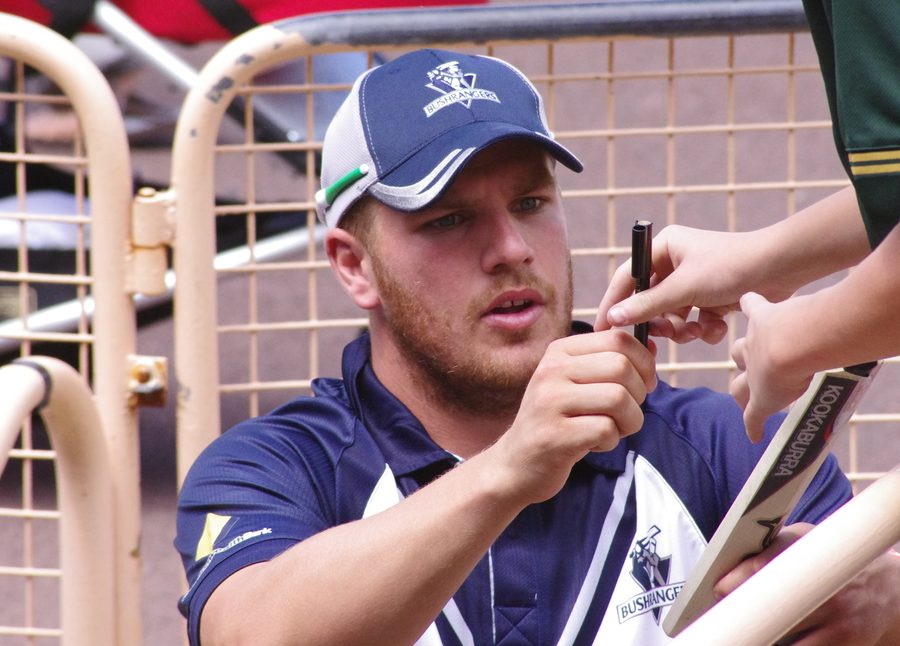
Aaron Finch retired as Australia's leading run-scorer in T20 internationals with 3,120 runs at 34.28, struck at 142.53. He captained the side in 76 of his 103 matches and led it to its first men's T20 World Cup, in the UAE in 2021. He made the highest individual score in the men's format's international history: 172 against Zimbabwe in Harare in 2018, which broke a record he already held with 156 against England.
Across eleven IPL seasons he played for nine different franchises and averaged 24.89.
That gap is the most interesting thing about him, and it is not explained by saying he had bad luck. Nine franchises is not bad luck; it is nine separate selection panels each concluding, after one or two seasons, that the best T20 international opener of his era was not worth keeping. Reading the two records side by side says something fairly precise about how the IPL differs from international T20, and about what kind of opener the two competitions reward.
The itinerary
The list is worth setting out in full because the sheer churn is the point.
| Season | Team | Inns | Runs | Avg | SR |
|---|---|---|---|---|---|
| 2010 | Rajasthan Royals | 1 | 21 | 21.0 | 100.0 |
| 2011-12 | Delhi | 8 | 102 | 12.8 | 104.1 |
| 2013 | Pune Warriors | 14 | 456 | 32.6 | 135.7 |
| 2014 | Sunrisers Hyderabad | 13 | 309 | 28.1 | 117.5 |
| 2015 | Mumbai Indians | 3 | 23 | 7.7 | 69.7 |
| 2016 | Gujarat Lions | 12 | 393 | 39.3 | 131.4 |
| 2017 | Gujarat Lions | 13 | 299 | 24.9 | 166.1 |
| 2018 | Punjab Kings | 9 | 134 | 16.8 | 134.0 |
| 2020 | Royal Challengers Bengaluru | 12 | 268 | 22.3 | 111.2 |
| 2022 | Kolkata Knight Riders | 5 | 86 | 17.2 | 141.0 |
Ninety innings, 2,091 runs, fifteen fifties, no hundred, a career strike rate of 128.2. Three seasons of real value — 2013 at Pune Warriors, 2016 and 2017 at Gujarat Lions — and seven that gave a franchise very little.
The 2020 season at Royal Challengers Bengaluru is the one that ended his IPL career in effect: twelve innings, 268 runs, a strike rate of 111.2, in a competition where the tournament-wide rate was already above 130. An opener striking at 111 is not a slow start; he is a fielding captain's asset.
What worked for Australia and not in India
The technical explanation is specific and it recurs in every serious assessment of Finch's batting. He was, more than almost any front-rank opener of his time, a batter who scored through the leg side off the front foot — a superb puller and flicker of anything short or on the hip, and a punisher of pace on a true surface. Against a new ball on a hard pitch with genuine carry, he was as destructive as any opener in the world.
He was correspondingly vulnerable to the ball that stopped, to quality off-spin turning across him early, and to surfaces where the ball did not come to the bat. That is a reasonable description of a substantial fraction of IPL pitches, and it also describes the specific tactic every Indian franchise developed for right-handed openers: an off-spinner in the first over, bowling into the pitch and across the batter, with the field set square.
The 172 came against Zimbabwe. The 156 that preceded it, in 2013, came against England at Southampton. He made hundreds in ODIs against strong sides on good pitches. That is not a slight on him: it is the same batter, and the conditions were doing much of the work in both directions.
The 172, and what it actually was
The Harare innings in July 2018 deserves its own description because record scores are usually flatter than their scorelines suggest, and this one was not. Finch made 172 from 76 balls with sixteen fours and ten sixes, in an innings where Australia made 229 for 2. He had made 156 against England five years earlier, so the two highest scores in T20 international history at that point belonged to the same player.
Twenty-six boundaries in 76 balls, against any opposition, is a rate of scoring very few batters have sustained across an entire innings. It was also, characteristically, a leg-side innings, much of it struck through the arc from midwicket to long-on.
The captaincy, which is the strongest part of the record
Finch's most substantial achievement is not in his own figures. He took over Australia's T20 side at a point when it was, by its own standards, poor — Australia had never won the tournament, had been eliminated early in several editions, and had a reputation in the format that lagged well behind its ODI and Test standing.
Australia won the 2021 T20 World Cup in the UAE, beating New Zealand in the final in Dubai. Finch made 5 in that final and was not a leading run-scorer in the tournament, which is close to the perfect illustration of what he provided: a settled batting order, an aggressive field, and a side that knew what it was trying to do. He had also led Australia in the 2019 World Cup semi-final run and captained in fifty-over cricket until retiring from the format in 2022.
He retired from T20 internationals in 2022 after a poor personal run, saying plainly that his own form no longer justified his place — a decision that reads better than the several careers in which the same call was made by somebody else.
The counter-argument worth taking seriously
There is a case that the IPL record understates him rather than revealing him, and it deserves a hearing.
Finch's IPL career was unusually badly served by circumstance. Six of his eleven seasons were spent at a franchise he had joined that year, which is the worst possible situation for an opener — no settled partner, no established role, and a squad list where an overseas opener is competing with two or three others for one or two slots. His two best seasons, 2016 and 2017, were his only two consecutive years at the same club, and in the second of those he struck at 166.1, which is the highest rate of any season in his career by a wide margin and suggests what a settled Finch looked like.
The Gujarat Lions were then dissolved. He went to Punjab and had a poor season, missed 2019, and by 2020 was 33 and playing on pitches in the UAE that suited him badly.
That is a real defence and it explains perhaps half the gap. It does not explain the other half, which is that nine sets of selectors, given the evidence in front of them, all reached the same conclusion.
What the two records together actually show
The lesson is not that Finch was overrated. He plainly was not: 3,120 T20I runs and a World Cup as captain settle that, and his record in the Big Bash and in county cricket is that of a genuinely excellent short-form opener.
The lesson is that "world-class T20 opener" is a less portable description than the market assumes. Finch's game was built for hard, true, bouncy surfaces against pace — Australian pitches, English white-ball pitches, the conditions in which most of his international cricket was played. The IPL asks a top-order batter to score against high-quality spin from the first over on surfaces that frequently offer nothing off the pitch, and it does so fourteen times a season for two months. Those are different jobs, and a batter can be outstanding at one and ordinary at the other without either record being a fluke.
For a competition that spends every auction paying for international form, that is a genuinely awkward finding. Finch is the clearest example in the IPL's history of an international T20 record failing to transfer, and the reason it matters is that the franchises kept buying it anyway — nine times.
What he leaves
Finch's place in Australian cricket is secure and rests on the captaincy and the T20I record rather than anything he did in India. The 172 has stood as the men's record since 2018; the 2021 title ended a decade in which Australia's failure in the shortest format had become an embarrassment; and the T20I run aggregate is a mark his successors are still chasing.
The IPL section of his career is a footnote to that, and an instructive one. Two thousand runs across nine franchises at 24.89 is the record of a useful overseas player who was never anybody's first-choice signing, produced by the same man who holds the highest score the format has seen.
Sources and method
IPL season and career figures are taken from official competition records and cross-checked against this site's own match dataset. T20 international totals, the 172 at Harare in 2018 and the 156 against England in 2013, the 2021 T20 World Cup result and Finch's retirement statements follow ICC and Cricket Australia sources and official scorecards. The account of his scoring areas and the tactics used against him is descriptive, drawn from published analysis and match reporting rather than computed from ball-by-ball data.