

The Wanderers Stadium: History of Johannesburg's Bullring
By CricketTaken EditorialPublished Updated Cricket in South Africa11 min read
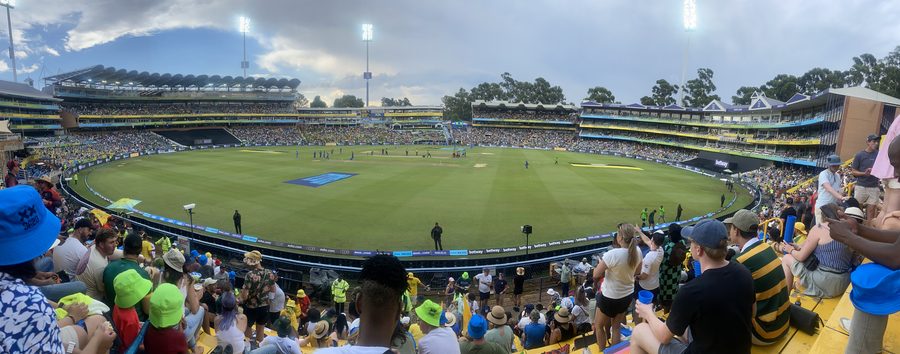
Every cricket country has one ground where the game is loudest, and in South Africa it is the Wanderers. Johannesburg's Test venue is known everywhere as the Bullring, a nickname earned honestly: the stands rise steeply on every side, the crowd sits close enough for a fine leg to hear individual opinions of his last over, and the noise folds back onto the field in a way that flat, open grounds never manage. Visiting captains talk about it the way footballers talk about hostile away ends. Home players talk about it as the ground where South African cricket feels most like a contact sport.
This page is the Bullring's biography: the original Wanderers ground that Johannesburg lost to a railway station, the move north to the present stadium, the Test history that accumulated there, the one-day international in 2006 that remains the most famous limited-overs match ever played, and the two World Cup finals — one fifty-over, one the first ever Twenty20 — that the ground has hosted. What the altitude does to a cricket ball, and how the Wanderers compares with the country's other Test venues, is covered in the site's guide to South Africa's grounds; this page is about the place itself and what has happened on it.
The old Wanderers, and how Johannesburg lost it
The Wanderers name is older than the stadium and older than almost everything in Johannesburg, which is not a high bar in a city founded on a gold reef in 1886. The Wanderers Club was formed in the town's first years, and its original ground sat in the middle of the young city, hard against the railway line near what became Park Station. The Old Wanderers, as it is now remembered, grew into the premier sporting ground of the Transvaal: cricket, athletics, cycling and football shared it, and from the mid-1890s it staged Test matches, joining the small circle of grounds that hosted international cricket in the era described in the site's account of how cricket arrived in South Africa.
For half a century the Old Wanderers was Johannesburg cricket. Touring England and Australia sides played there on every visit; the Transvaal teams that fought Currie Cup battles against the coastal provinces called it home; and the matting-then-turf story of early South African pitches played out on its square. Then the city took it. After the Second World War, the railways needed the land for the expansion of Johannesburg's central station, the ground was expropriated, and one of the oldest Test venues in the world disappeared under platforms and track. It remains among the very few grounds anywhere to have hosted Test cricket and then been erased from the map entirely.
The compensation, in land and money, funded the move. The Wanderers Club re-established itself several kilometres north in the suburb of Illovo, on a large campus that still holds the club's many sections today, and alongside it rose a purpose-built cricket stadium. The new Wanderers opened in the mid-1950s and staged its first Test during England's 1956-57 tour. Johannesburg cricket had a home again, and this time nobody was building a railway through it.
Why they call it the Bullring
The new stadium's defining decision was architectural: instead of the low, spread-out pavilions and grass banks typical of South African grounds, the Wanderers was built as a bowl, with tiered stands encircling the playing area and rising steeply from the boundary. Later redevelopments — most extensively in the 1990s after readmission, when the ground was modernised for the television era — deepened the effect rather than diluting it. Stand replaced bank, roofline rose, and the enclosure tightened.
The result is a ground that holds sound. A wicket at a quiet moment produces a roar out of proportion to the attendance; a full house produces something touring batters have compared to walking into an arena, which is precisely the image the nickname carries. The bullring effect is not just theatre. Fast bowlers, the currency of South African cricket and the subject of the site's guide to the fast bowling tradition, feed on the noise, and the combination of a loud crowd, a quick pitch and thin highveld air has made the Wanderers the venue where touring top orders are most likely to be blown away in a session. Domestically the ground is the headquarters of the Gauteng lions of the old Transvaal line — the dominant force for long stretches of the provincial story told in the Currie Cup history — and in the franchise era it hosts SA20 cricket each January, part of the calendar mapped in the SA20 season archive.
Test cricket at the Bullring
The modern Wanderers has hosted Test cricket for seventy years, with a twenty-year hole in the middle where isolation should have been the ground's prime. Some chapters carry more weight than others.
The pre-isolation ground saw the great South African sides of the 1960s, and the last Tests before the walls closed in 1970 — the era, and its cost, are set out in the history of South Africa cricket. When international cricket returned in the 1990s, the rebuilt Wanderers became the venue for the biggest home fixtures, and its Test identity settled into what it remains: the fastest, bounciest, most partisan examination on the tour itinerary.
Three modern Tests define the ground's character from three different angles.
The Atherton rearguard, 1995. England, set over four hundred to win, were saved by their captain Michael Atherton batting more than ten hours for an unbeaten 185, one of the great defensive innings in Test history, with wicketkeeper Jack Russell clinging on beside him through the final sessions. The Bullring roared all day and got nothing. The innings is remembered in England as a career definition and in Johannesburg as the one that got away.
The 458 chase that nearly was, 2013. India left South Africa a target of 458, and on a final day that swung by the hour, Faf du Plessis and AB de Villiers both made hundreds and carried the chase to the very edge — South Africa finished on 450 for seven, eight runs short, declining the risk of losing in pursuit of the highest successful chase ever. A draw, and one of the most gripping Tests of its decade.
The suspended Test, 2018. The third Test against India was played on a surface so spiteful that after a batter was struck the umpires took the players off and the match hovered on the brink of abandonment before resuming; India won on it. The episode was the dark side of the Wanderers formula — pace and bounce pushed past the limit — and it cost the ground official sanction. Even the venue's failures are expressions of its identity.
Around these set pieces runs a broader pattern: Wanderers Tests are short, result-heavy and bowler-driven. Careers here are made by fast bowlers and by batters brave enough to counter-attack, and the ground's honours boards lean accordingly. Jacques Kallis, a Wanderers regular across two decades of Transvaal-line and Test cricket, and Hashim Amla, whose wrists turned the ground's pace into scoring, are among the batters who mastered it; most visitors did not.
The 438 game
On 12 March 2006, the Wanderers staged the fifth and deciding one-day international of a series between South Africa and Australia that stood at two apiece, and produced the most famous limited-overs match ever played.
Australia batted first and made 434 for four, the first score past four hundred in the history of one-day internationals, Ricky Ponting striking 164 from 105 balls in one of the great one-day innings. The record had stood at 398 for a decade; Australia had beaten it by 36, at a ground where the thin air turns good hits into flat sixes. At the interval the match was considered over, and the South African dressing room, by its own later accounts, half agreed.
The chase that followed rewrote the format's sense of the possible. Graeme Smith launched it with 90 from 55 balls, and Herschelle Gibbs played the innings of his life: 175 from 111 deliveries, an innings that outdid Ponting's for audacity because of what it was chasing. Wickets kept falling; the required rate never quite escaped; and it came down to the last over with the tail in. Mark Boucher, the coolest head on the ground, was still there at the end, and the winning boundary came with one wicket standing and a ball to spare. South Africa 438 for nine. Eight hundred and seventy-two runs in the day, both one-day batting records broken in a single match, a series decided, and a game that South Africans simply call "the 438 game" with no further explanation needed.
Two details complete the story. The match ended the record one-day winning run Australia carried into it, in the middle of the era when the rivalry between South Africa and Australia was the hardest-edged in cricket. And it permanently changed the mental arithmetic of the fifty-over game: after Johannesburg, no total was safe, and the scoring standards of the following two decades treat that afternoon as their starting point.
Two World Cup finals
The Wanderers is one of the few grounds to have staged the final of two different world tournaments, in two different formats, four years apart.
The first was the final of the 2003 fifty-over World Cup, the tournament South Africa hosted with matches across the country and beyond. The final itself, on 23 March 2003, was one-sided: Australia made 359 for two, Ponting striking an unbeaten 140, and India were beaten by 125 runs. It sealed an unbeaten tournament for Australia and a second consecutive title in the sequence recorded in the 2003 World Cup archive. For the host nation the tournament is remembered with a wince — the home side's exit involved a misread rain calculation and remains a national scar tissue — but the final gave the rebuilt Wanderers the biggest fixture the fifty-over game has to offer.
The second final mattered even more to the sport's direction. In September 2007 South Africa hosted the first ICC World Twenty20, the tournament that would decide whether the newest format had an international future, and the Wanderers staged its climax: India against Pakistan, the two countries whose reaction would determine the format's fate. India won a frantic final by five runs, the tournament — whose full record is in the 2007 T20 World Cup archive — was a runaway success, and within months the Indian Premier League existed. It is only a slight exaggeration to say the modern franchise economy was ratified at the Wanderers. The same tournament gave the ground another first: Chris Gayle, opening for West Indies against the hosts in the tournament's opening match, struck the first century ever scored in Twenty20 internationals.
Pink day
The Wanderers' own contribution to the international calendar is the pink one-day international. Since the early 2010s, one home ODI at the ground each summer has been played in pink — pink kit, pink stands, a full house — to raise money and awareness for breast cancer causes, and the fixture has grown into one of South African cricket's genuine occasions, routinely selling out whoever the opposition is.
The pink fixtures have also produced an outsized share of extraordinary cricket, none more so than 18 January 2015, when AB de Villiers came to the crease against West Indies and reached his hundred in 31 balls — the fastest century in the history of one-day internationals, on his way to 149 from 44 deliveries. That such a record was set at the Wanderers surprised nobody: thin air, fast outfield, short straight boundaries by Test-ground standards, and a batter in the form of his life. The day sits alongside the 438 game in the ground's one-day folklore, and the two together explain why bowlers regard a Wanderers ODI as the hardest shift in the country.
The ground in the domestic and franchise age
Between the international set pieces, the Wanderers earns its living as a working cricket ground. It is the home of the Lions provincial side, the modern carrier of the Transvaal tradition, in the top tier of the structure described in the domestic cricket guide. It stages a full programme of first-class, one-day and T20 domestic cricket, and since 2023 it has been a January home of SA20 franchise cricket, which has returned full, loud houses to the ground with a regularity Test cricket no longer guarantees.
That last point is the honest note on which any modern history of the ground has to end. The Wanderers' economics, like every South African ground's, have tilted toward white-ball and franchise cricket; Test matches at the Bullring are rarer than they were, and the country's Test future is negotiated board-to-board rather than earned gate-by-gate. What the ground retains is what it has had since the 1950s: when a big match does come, there is nowhere in the country, and few places anywhere, where cricket is louder. The rest of the site's South African coverage — the other grounds, the structures, the history feeding into all of it — is collected on the cricket in South Africa hub.
Sources and method
Ground history — the Old Wanderers' expropriation for railway expansion, the move to Illovo, the first Test at the new ground in the 1956-57 England series — follows the standard published histories of South African cricket and the Wanderers Club's own record. Match details for the Tests and one-day internationals described, including the 2006 match figures, the 2003 and 2007 finals and the 2015 fastest hundred, come from the published international scorecards. Capacity figures and redevelopment costs are deliberately omitted as they change with each rebuild. Where a precise date or figure could not be verified with confidence, the fact is described in general terms instead. This site has no affiliation with the Wanderers Club, the Lions, Cricket South Africa or any competition named.