

R Premadasa Stadium: Sri Lanka's Floodlit White-Ball Home
By CricketTaken EditorialPublished Cricket in Sri Lanka9 min read
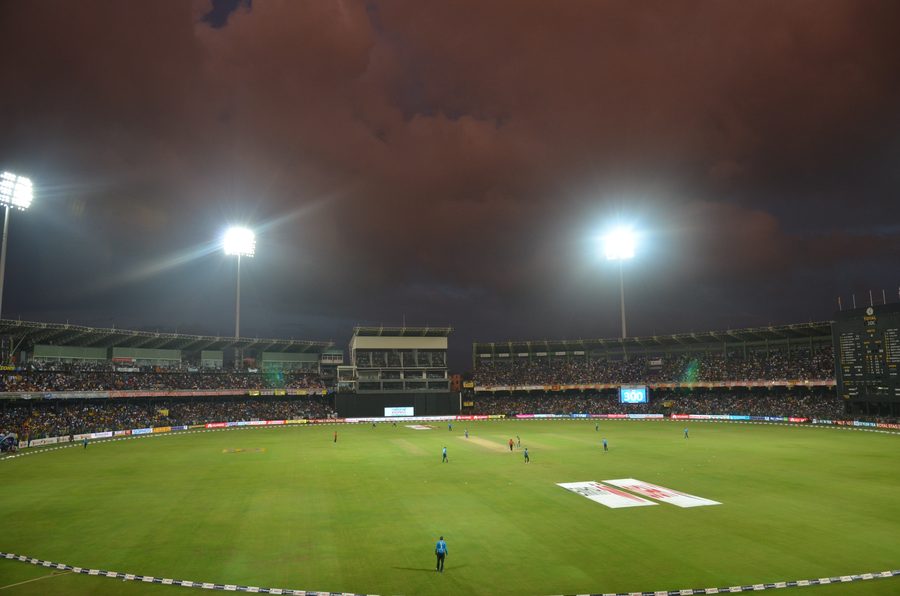
Sri Lanka's traditional cricket grounds were inherited: club grounds, school grounds, a converted racecourse by the sea. The R Premadasa Stadium is the great exception. It was built on purpose, on reclaimed marshland in a crowded working district of Colombo, to be something the country had never had — a big, modern stadium that belonged to the national game rather than to a members' institution. Four decades later it is the island's largest cricket ground, the home of its night cricket, and the venue where most Sri Lankans have actually watched their team play.
This page tells that ground's story: where it came from, the strange and spectacular things that have happened on it, and the specific way it shapes the matches it hosts. Its place among the island's other venues, pitch by pitch, is sketched in the cricket grounds guide; here the subject is the stadium itself.
Out of the marsh: the Khettarama project
The ground began life in the 1980s as the Khettarama Cricket Stadium, taking its name from its neighbourhood near the Maligawatta area of Colombo, and its site had to be made before the stadium could be built on it: low, wet ground on the flood plain side of the city, drained and filled into a playing field. Nothing about the location said garden suburb. Where the established Colombo grounds sat among the trees of Cinnamon Gardens, Khettarama went up amid dense housing and city noise, and that contrast has always been part of its identity. The old grounds belonged to the clubs and the schooled elite; the new one was reachable, affordable and enormous by local standards, and it filled with a crowd the club grounds had never drawn.
The stadium entered international cricket in the mid-1980s and was renamed in 1994 in memory of President Ranasinghe Premadasa, who had been assassinated the previous year and with whose government the project was closely associated. Older fans still say Khettarama; scorecards say R Premadasa Stadium; both names refer to the same essential fact, the first ground in the country conceived at national-stadium scale.
Lights on: the night game arrives
The Premadasa's most consequential feature is the one that sounds most mundane: floodlights. It became the country's ground for day-night international cricket, and that single capability reorganised the island's cricket geography. Once matches could start in the afternoon and finish under lights — the only sensible arrangement in a climate where the working day and the tropical evening both argue against morning starts — the one-day international programme migrated to the ground that could stage it, and stayed.
The consequences compounded. Evening cricket brought bigger crowds, bigger crowds justified expansion, expansion made the ground the automatic venue for tournament cricket, and tournament cricket kept the lights earning. The Sinhalese Sports Club ground retained the Tests and the ceremony; the Premadasa took the volume. That division of labour between Colombo's two big grounds — heritage at Maitland Place, floodlit scale at Khettarama — has held for a generation and shows no sign of reversing.
The 952 match: a Test-ground footnote written in capitals
For a venue defined by the white-ball game, the Premadasa owns one of the most extraordinary entries in the Test record book. In August 1997, against India, Sri Lanka batted into the sixth day of a timeless-feeling match and declared at 952 for 6 — the highest team total in the history of Test cricket. Sanath Jayasuriya made 340, Roshan Mahanama 225, and their stand of 576 was at the time the largest partnership Test cricket had seen, for any wicket.
Two things make the match worth more than its trivia value. First, it certified the character of the surface: flat, slow, and utterly without malice, an honest exaggeration of the qualities the ground shows in its one-day colours. Second, its records became a family affair — the 576 was overtaken nine years later by the 624 that Sangakkara and Jayawardene assembled across town at the SSC, so that the two grandest stands in the format's history stand a short drive apart in the same city. The 952 remains unbeaten. Nobody who has watched a modern over-rate expects it to fall soon.
Tournament theatre
The Premadasa is where Sri Lanka stages its biggest nights, and its tournament file is thick with drama, some of it glorious and some of it painful.
The 1996 World Cup touched the ground in the strangest way a venue can be touched: by absence. After the January 1996 bombing in Colombo, Australia and West Indies declined to play their scheduled group matches in the city, and Sri Lanka took the points by forfeit — walkovers that sent an unbeaten and underestimated side onward to the title, won in Lahore. The ground had been ready; the matches never happened; the trophy came home anyway.
The 2002 Champions Trophy gave the stadium the most anticlimactic finale in the sport's history. The final, Sri Lanka against India, was washed out; the reserve day was washed out too; the trophy was shared. Two full stagings of a final, no result, half a title each — it happened here.
The 2011 World Cup brought reconstruction and a semi-final. The stadium was substantially rebuilt for the tournament, emerging with the largest capacity in the country, and repaid the investment with a home semi-final in which Sri Lanka beat New Zealand to reach the final in Mumbai. The 2012 World Twenty20 went one better and one worse: the Premadasa staged the final itself, and a full house watched West Indies beat Sri Lanka — the fourth global final the national side had lost since 2007, this one at home, which gave the night a weight local supporters have not forgotten. The wait ended two years later in Dhaka, but the hurt was minted here.
The 2023 Asia Cup added the most brutal entry. In the final, India bowled Sri Lanka out for 50 — the hosts' lowest one-day total against India, on their own flagship ground — and won inside a session of what was meant to be a full evening's occasion. Big stadiums hold big memories of both kinds, and the Premadasa declines to curate.
What the ground does to a match
The Premadasa's playing character is the most tactically loaded in the country, and its logic is worth walking through, because it decides matches before a ball is bowled.
The surface is slow, and it gets slower. Ball one of an evening fixture is the fastest the pitch will be all night; from there the ball grips more, arrives later, and punishes batters who plan to hit through the line. Spinners and cutter-bowling seamers grow into the innings. So far, so subcontinental. What tilts the ground is the dew. On many evenings a wet outfield arrives with the second innings, the ball skids on rather than gripping, spin loses its teeth, and the pitch a chasing side receives is kinder than the one the first innings was played on. The toss therefore carries unusual weight in day-night matches here, and captains who win it tend to chase — a pattern visible across years of results rather than any single game.
The strategic consequences radiate outward. Sides batting first at the Premadasa aim for totals that look modest by world standards and defend them with slow bowling before the dew arrives; the mystery spinners the island keeps producing, whose lineage is traced in the history of mystery spin, have made careers of those first-innings squeezes. Bowlers of a different kind have thrived here too — Lasith Malinga built much of his mastery of the death overs on slow Premadasa pitches, where his yorkers and slower balls compounded everything the surface already did. Records for these players and their contemporaries sit in the player index.
The domestic stage: LPL nights and the calendar
Between international assignments the Premadasa anchors the domestic white-ball game. It is the natural home of the Lanka Premier League's Colombo fixtures and its showpiece matches, for the same reasons it hosts everything else of scale: lights, capacity and the city's population on its doorstep. Domestic one-day and T20 finals gravitate to it, A-team day-night fixtures use it, and its practice facilities and indoor school serve the national squads.
That workload gives the ground a different rhythm from the club venues. The SSC's square lives a double life between club championship and Test match; the Premadasa's year is a rolling sequence of staged events, each needing the full apparatus of a modern stadium. One is a home that hosts; the other is a venue, in the full professional sense, and the difference between those two models is the difference between the island's cricket past and its cricket present.
| Aspect | The Premadasa in brief |
|---|---|
| Original name | Khettarama Cricket Stadium |
| Renamed | 1994, after President Ranasinghe Premadasa |
| Setting | Built on reclaimed marshland in a dense district of Colombo |
| Role | Principal day-night and white-ball venue; largest ground in the country |
| Test claim | Sri Lanka's 952 for 6 against India, 1997 — the highest Test total |
| Big nights | 2002 Champions Trophy final, 2011 World Cup semi-final, 2012 World T20 final, 2023 Asia Cup final |
Following a match at the Premadasa
For a spectator, the Premadasa offers the version of Sri Lankan cricket the club grounds cannot: scale, noise, papare bands, and an evening crowd that arrives after work and stays past the fireworks. It is the ground for a first-time visitor who wants an occasion rather than an education.
For the follower at a distance, three habits repay themselves. Check the start time — an afternoon start means dew is in play and the toss matters accordingly. Check the totals history rather than assuming par — scores here run below the global norm, and a side defending what looks like a thin total is often ahead of the game. And check the team sheets for slow-ball specialists, because this is the venue where they earn their keep. The wider context for any match here — how the national side is run, where its players come from, what the rest of the season looks like — is collected on the cricket in Sri Lanka hub, and the longer story of the team the stadium was built to serve is in the history of Sri Lanka cricket.
Sources and method
This guide draws on the public record of international cricket at the Khettarama/R Premadasa ground from the mid-1980s onwards, including the August 1997 Test against India and its world-record total and partnership, the 2002 ICC Champions Trophy final washouts and shared title, the forfeited Colombo group matches of the 1996 World Cup, the 2011 World Cup semi-final, the 2012 World Twenty20 final and the 2023 Asia Cup final; and the documented renaming of the stadium in 1994. Pitch behaviour and the influence of dew are described from the aggregate pattern of published results at the venue rather than from any single match, and are stated qualitatively because surfaces and conditions vary. No capacity figures, ticketing details or current facilities information are given. CricketTaken is an independent publication with no affiliation to Sri Lanka Cricket or to any venue named here.