

Faf du Plessis, Built for the Innings Nobody Wants
Faf du PlessisSouth Africa
By CricketTaken EditorialPublished Player analysis7 min read
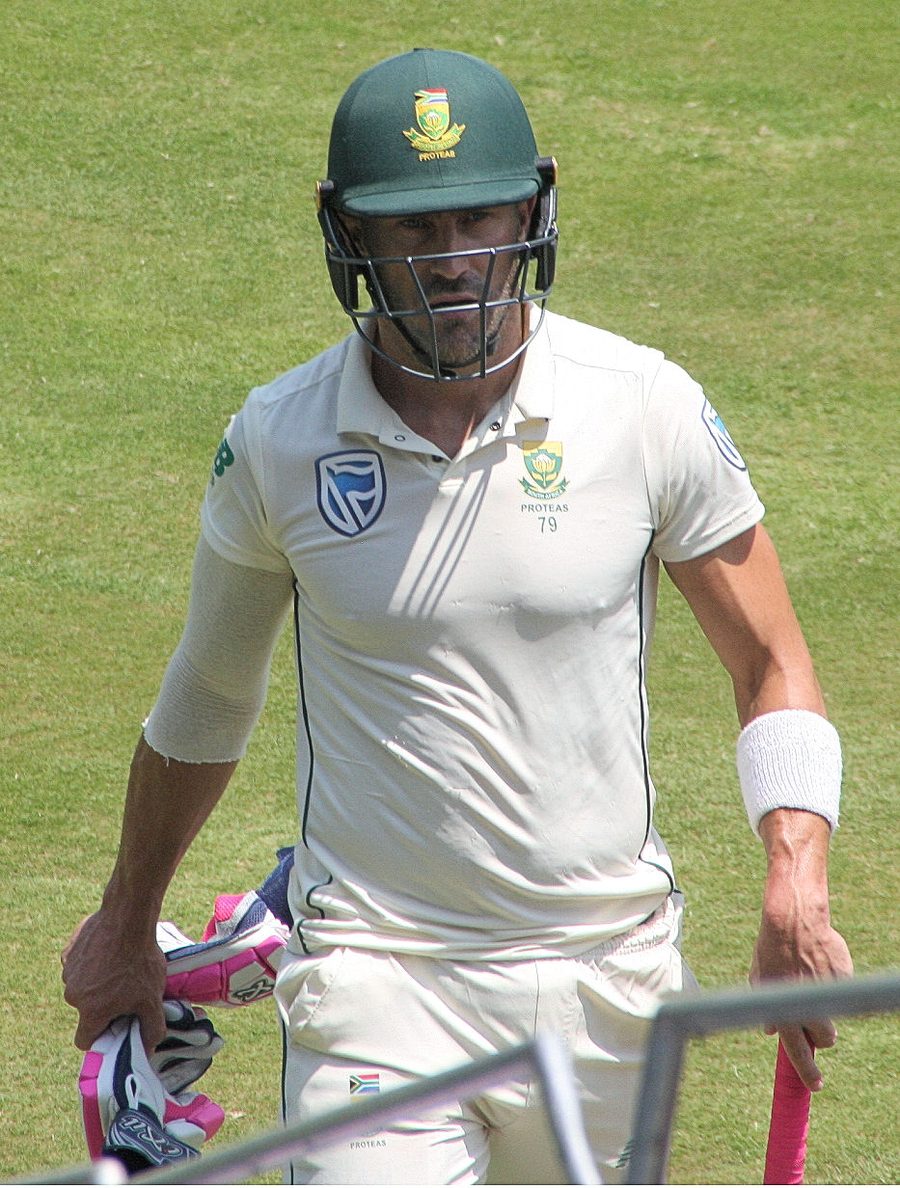
There is a category of innings that wins nothing and decides everything, and Faf du Plessis built a career out of it. He announced himself with 110 not out on Test debut, batting most of a day to save a match South Africa were losing, and the rest of his career kept returning to the same assignment in different clothes: hold this together, because if you do not, it collapses. He then inherited the captaincy of a side entering the most turbulent decade in its history and did the same job with that. The record of a crisis batter is hard to read from an average, which is why du Plessis is consistently ranked below the players he outperformed.
Adelaide, November 2012
The debut is the right starting point because everything else is a variation on it. South Africa were on the fifth day at Adelaide, behind, needing to survive to keep their series against Australia alive and their claim on the number one ranking intact. Faf du Plessis came in on debut, aged 28 after years of waiting behind a batting order that included Kallis, Amla, Smith and de Villiers, and batted through to the close.
He made 110 not out. He first added 89 with AB de Villiers, who faced 220 balls for 33 in the innings that best demonstrates his own range, and then 99 more with an injured Jacques Kallis. The match was drawn, the first time since 1921 that Australia and South Africa had played two consecutive draws, and South Africa won the series in Perth. ESPNcricinfo called it one of the great modern rearguards, and it is difficult to argue: it was a debutant, in a foreign country, batting to save rather than to win, with the innings in his hands from the moment he arrived.
A debut like that shapes how a player is used for a decade. Du Plessis was thereafter the man South African captains sent in when the situation was awkward, which meant he batted more often at four or five with two wickets down early than at three with a platform.
The one-day record is the one to look at
The Test career finished with 4,163 runs at 40.02 from 69 matches, ten centuries, which is good rather than remarkable. The one-day record is where he was genuinely first-rate and it gets a fraction of the attention: 143 matches, 5,507 runs, an average of 47.47 and twelve centuries.
An average approaching 48 in one-day international cricket puts a batter in a small group. In August and September 2014 he scored three consecutive centuries and missed a fourth by four runs, which is the kind of run that would define most players' careers and barely features in accounts of his. He was the anchor in a South African order that had de Villiers at its centre and needed somebody to bat around him — which meant, again, absorbing pressure so that the more spectacular player could operate.
The 2019 World Cup was the low point and he was captain for it. South Africa were poor, lost early games, and were out of contention before the halfway mark. Du Plessis was one of very few players in the squad who batted well, and he took the criticism for the campaign, which is how captaincy works.
The captaincy, and the circumstances he got it in
Du Plessis was given the T20 captaincy in December 2014, having played only four matches in the format, and the Test captaincy in December 2016 when de Villiers stood down. He held the Test and T20 roles until February 2020.
The captaincy record is respectable and in one-day cricket it was better than that: a win rate near 74%, and he became the first international captain to whitewash Australia 5-0 in an ODI series, in 2016. In Tests he won series against Sri Lanka, Pakistan and — the one that mattered most — 2-1 at home against India in 2017-18, a result achieved against the best Test side in the world at the time.
What the record does not show is the environment. His tenure ran through the collapse of the Kolpak floodgates and the departure of a generation of players, an escalating governance crisis at Cricket South Africa, the transformation targets that every selection had to satisfy, and the retirement or exit of de Villiers, Hashim Amla, Dale Steyn, Morne Morkel and JP Duminy inside a few years. He captained the Proteas through the years when the resource base that had made them number one drained away, and he was blamed for the results.
There was also Hobart in November 2016 — the incident that became "mintgate", where he was found guilty of ball tampering and fined his full match fee, having pleaded not guilty and denied wrongdoing throughout. He captained the side through the immediate aftermath and made a hundred in the next Test, which was characteristic.
He retired from Test cricket in February 2021, aged 36, saying he wanted to concentrate on the shorter formats and give the side time to build for the next cycle. He played his last T20 internationals in the 2021 World Cup, where South Africa won four of five games and were eliminated on run rate.
Chennai, then Bangalore
The franchise career is not a coda. It is a third act with its own arc. Du Plessis joined Chennai Super Kings in 2011 and was there, with two seasons at Rising Pune Supergiant during Chennai's suspension, until 2021. He was part of the sides that won in 2011, 2018 and 2021, opening with Ruturaj Gaikwad in that final year and finishing as the tournament's second-highest scorer at 37.
Then Royal Challengers bought him in the 2022 auction and made him captain. He led them for three seasons and produced the best individual batting of his career in the process: 468 runs in 2022, then 730 runs in fourteen innings in 2023 at a strike rate above 153 with eight fifties, which was the highest aggregate in the tournament that year by a Royal Challengers batter and among the best in the competition.
That is worth stating clearly. Du Plessis's most productive IPL season came at 38, in his sixteenth year as a professional, while captaining. His overall record in the competition is close to 4,800 runs, with a strike rate that rose steadily through his thirties — the inverse of the usual curve, and the result of a deliberate technical shift towards hitting straight and over the leg side that he has discussed at length.
He has since kept going: SA20 with Joburg Super Kings, the PSL, the CPL, the Big Bash, and Major League Cricket in the United States, where he holds the record for the most centuries in the competition's history. A player who was 28 before he played a Test has ended up with one of the longest careers of his generation.
Why he is undervalued
There are two structural reasons du Plessis is ranked below where his record puts him.
The first is that he played his whole international career in the shadow of better-known team-mates. In a batting order containing Kallis, Amla, Smith and de Villiers, the fourth-best batter is invisible, and du Plessis was rarely even framed as the fourth-best. His statistical peers in that side had reputations he never had.
The second is that crisis batting does not photograph well. An unbeaten 110 to draw a Test is worth more to a side than a hundred in a 300-run win, and it is remembered less, because nothing happened at the end of it. Du Plessis's career is disproportionately made of innings in that category — the Adelaide debut, the fourth-innings resistance, the World Cup fifties in games South Africa lost, the anchoring role in a T20 order that needed one.
The measure
He finished with an ODI average near 48, a Test average of 40 accumulated mostly in difficult batting positions, a captaincy record that stands up in every format, and a franchise career that peaked after he had stopped playing for his country. Set against the great South African batters he is not in the first rank, and he would not claim to be.
What he was, more consistently than anybody else of his era, was the player a captain wanted at the crease when the game had already gone wrong — and then, for four years, the captain who had to make those decisions himself, for a team whose best years were behind it and whose administration was coming apart. Both jobs are thankless. He did them for a decade and never once appeared to be enjoying the difficulty, which is probably the most South African thing about him.
Sources and method
Career figures, captaincy records and match details come from published scorecards, ICC records and Cricket South Africa sources. Captaincy win percentages quoted are published figures. The account of the 2016 Hobart charge reflects the published finding and his own stated position. Judgements about the administrative environment of his tenure are descriptive.