

Axar Patel's IPL Career, from Punjab Kings to Delhi Captain
Axar PatelIndia
By CricketTaken EditorialPublished Player analysis8 min read
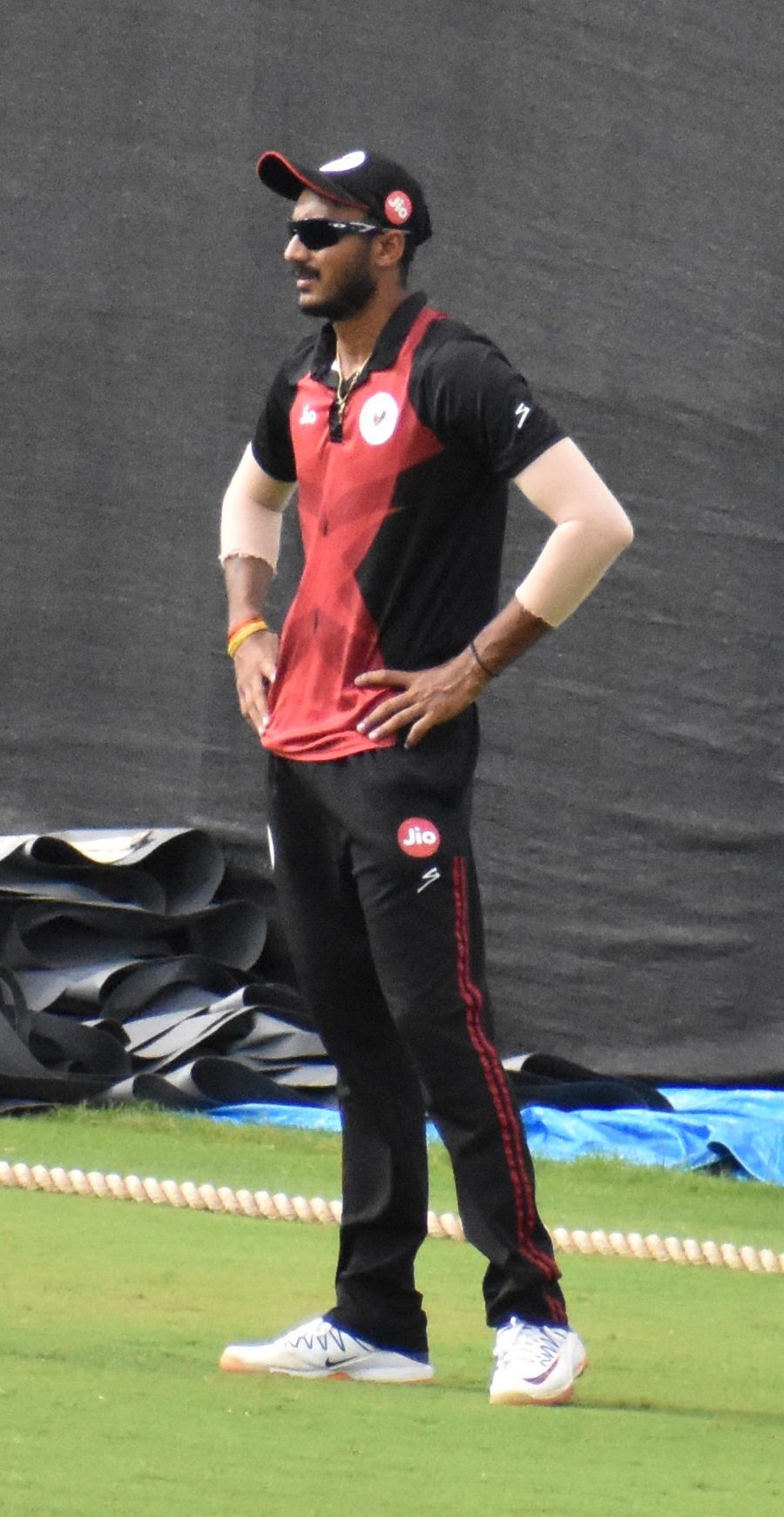
Franchise cricket rarely rewards a bowler whose main product is the absence of events. Axar Patel has built one of the Indian Premier League's most durable careers on exactly that: 139 wickets in 173 matches, an economy rate of 7.43 across an era in which league-wide scoring rates rose every second season, and a batting strike rate of 133.7 from the lower middle order. No hundred, no Purple Cap, no season in which he was the story. What there has been instead is thirteen consecutive seasons of a captain knowing, before the toss, that four overs of the innings were already accounted for.
Five seasons at Punjab Kings
Punjab picked him up as a twenty-year-old left-arm spinner from Gujarat ahead of the 2014 season, and he went straight into a side that had been rebuilt around power hitting. The batting order contained Glenn Maxwell, David Miller and Virender Sehwag, with George Bailey captaining, and the campaign those players produced remains the best in the franchise's history: top of the league table, then a defeat to Kolkata Knight Riders in the final.
Inside that noisy team, the quiet job belonged to the newcomer. Patel bowled his full allocation almost every match, mostly in the middle overs, and conceded so little that opponents largely stopped attacking him and took their chances elsewhere. His wicket tally that year was substantial for a spinner in his first season, and the league's emerging player award followed early in his Punjab spell. The bat was an afterthought: 62 runs in seven innings in 2014, though a 42 hinted that there was hitting in there somewhere.
The next four seasons at Punjab Kings settled into a pattern. The team churned captains and finished mid-table or worse; Patel kept bowling his four overs for not very much. His batting fluctuated with his role. In 2015 he made 206 runs at a strike rate of 118.4, in 2017 he produced his best Punjab return with the bat, 227 runs at an average of 28.4 and a strike rate of 140.1, and in 2018 the runs dried up almost completely, 80 of them at a highest score of 19. Punjab let him go at the end of that year. Across five seasons he had been their most dependable bowler and their least resolved batting question, and the franchise chose to start again.
The 2019 move to Delhi
Delhi Capitals signed him at the auction before the 2019 season, and the fit was better than the fee suggested. Delhi were assembling a young side around Rishabh Pant, Prithvi Shaw and Shreyas Iyer, with Kagiso Rabada leading the attack, and what they lacked was a spinner who could be trusted with difficult overs on the small, flat Kotla square. Patel gave them that immediately. The 2019 side reached Qualifier 2, the franchise's deepest run in seven years, and his role in it was characteristic: 110 runs at a strike rate of 125 when the innings needed a shove, and an over-by-over meanness that let the leg-spin of Amit Mishra and the pace of Rabada hunt at the other end.
The 2020 season, played in the United Arab Emirates, took Delhi further still, all the way to the final, where Mumbai Indians beat them comfortably. Patel's contribution through that campaign is a good miniature of his value. On slow Emirati pitches his skidding left-arm spin was close to unhittable, and with the bat he struck at 137.6 in the lower order, including a sequence of late-innings cameos built almost entirely on straight sixes. The 2021 season was quieter, six innings and 40 runs while injuries interrupted him, but Delhi topped the league table that year and his bowling economy stayed where it always stays.
What an economy of 7.43 actually buys
The headline bowling numbers, computed from ball-by-ball data, are 173 matches, 139 wickets, 3,586 balls, 4,438 runs conceded, an average of 31.93 and an economy of 7.43. The average looks ordinary and the economy looks merely decent until both are put in context.
A Twenty20 bowling average is a poor measure of a bowler whose job is prevention. Patel has never been used as a wicket-hunter; he is used to bowl the overs in which the opposition's best hitters are set, frequently against left-handers he can turn the ball away from, and often into the powerplay when a match-up favours him. Wickets in those overs are a bonus. Runs saved are the product. An economy of 7.43 held across thirteen seasons, through rule changes, the impact substitute and two general inflations of scoring, means he has conceded roughly a run an over fewer than the league's prevailing rate for most of his career. Over a four-over spell that is four to six runs, which is the margin by which a large fraction of Twenty20 matches are decided.
The method is the same one that works for him in Test cricket, adapted for shorter boundaries. He bowls quick, flat and at the stumps, gives the batter almost no width and no time to get down the pitch, and uses the ball that goes straight on as the primary threat. Batters trying to hit him through the leg side against the skid find the ball arriving earlier than the swing expects. It is not spectacular, and it does not produce many viral dismissals. It produces dot balls, and dot balls in the middle overs are the currency the format actually runs on.
The batting record, season by season
His full IPL batting figures, all thirteen seasons:
| Season | Team | Inns | Runs | Avg | SR | HS |
|---|---|---|---|---|---|---|
| 2014 | Punjab Kings | 7 | 62 | 10.3 | 103.3 | 42 |
| 2015 | Punjab Kings | 12 | 206 | 22.9 | 118.4 | 40 |
| 2016 | Punjab Kings | 10 | 111 | 15.9 | 144.2 | 36 |
| 2017 | Punjab Kings | 13 | 227 | 28.4 | 140.1 | 44 |
| 2018 | Punjab Kings | 8 | 80 | 13.3 | 115.9 | 19 |
| 2019 | Delhi Capitals | 12 | 110 | 18.3 | 125.0 | 26 |
| 2020 | Delhi Capitals | 9 | 117 | 14.6 | 137.6 | 42 |
| 2021 | Delhi Capitals | 6 | 40 | 8.0 | 87.0 | 12 |
| 2022 | Delhi Capitals | 10 | 182 | 45.5 | 151.7 | 42 |
| 2023 | Delhi Capitals | 13 | 283 | 28.3 | 139.4 | 54 |
| 2024 | Delhi Capitals | 12 | 235 | 29.4 | 131.3 | 66 |
| 2025 | Delhi Capitals | 11 | 263 | 26.3 | 157.5 | 43 |
| 2026 | Delhi Capitals | 11 | 173 | 17.3 | 131.1 | 56 |
The career line beneath the table reads 2,089 runs from 134 innings at an average of 21.54 and a strike rate of 133.74, with four fifties, a highest score of 66, and 100 sixes against 146 fours. That last pair of numbers is the revealing one. Most batters with two thousand IPL runs have hit far more fours than sixes; Patel's ratio is close to two to three the other way round relative to the norm. He does not accumulate. He arrives late, defends or rotates for a handful of balls, then hits straight and hits hard, and the six over long-on is his stock scoring shot the way the arm ball is his stock delivery.
The 2022 shift, when the hitting became a plan
The table has an obvious hinge in it. Up to 2021, his batting seasons were erratic and mostly modest. From 2022, they were not. That year he made 182 runs in ten innings at an average of 45.5, inflated by six not-outs, at a strike rate of 151.7. The average is a quirk of unbeaten cameos, but the strike rate was not a quirk, and it has stayed high since: 139.4 in 2023, when he passed fifty in the league for the first time, 131.3 in 2024 with two fifties and a new highest score of 66, and 157.5 in 2025.
What changed was partly him and partly the game around him. His work against pace at the death improved noticeably, particularly the yorker-length ball he had previously only dug out and now started forcing square. At the same time, Delhi began treating him as a genuine batting resource rather than insurance, promoting him when a left-hander was needed against wrist spin and trusting him to finish chases. The player Punjab released in 2018 as a bowler who batted had become, in the modern jargon, a two-skill cricketer whose second skill was no longer notional. His run of national white-ball selection over the same period, covered in the piece on his 2024 T20 World Cup and white-ball role, followed directly from that change.
Captaincy of Delhi Capitals
Delhi's leadership passed around considerably in the 2020s, from Iyer to Pant, through stand-ins during Pant's recovery from his car accident, and Patel served a long apprenticeship as the senior professional and occasional vice-captain. Ahead of the 2025 season the franchise made it formal and appointed him captain.
The choice was less romantic than it looked and more logical. Captaincy in this league sits most comfortably with a player whose own game is low-maintenance, and no one in the squad had a more settled role than the man who had bowled the same four overs to the same field for a decade. His first season in charge coincided with one of his better batting years, 263 runs at a strike rate of 157.5, and the side stayed competitive deep into the season. The 2026 campaign brought 173 runs including a fifty, and the same four overs, at the same cost, as ever.
Where the record sits
Thirteen seasons, two franchises, one final reached with each, no title. That summary undersells him in the specific way this league's records tend to undersell bowlers of his type, because nothing in a scorecard column records the over that went for five when the batting side needed eleven. The fairer measure is longevity of trust: since 2014 there has been no season in which his captain did not give him his full quota, no reinvention forced on him by the market, and no auction in which Delhi Capitals considered life without him.
His international career ran on a different track, from the Test debut series against England that produced twenty-seven wickets, examined in the piece on his 2021 England Tests, to a central white-ball role. But the IPL is where the shape of his cricket was formed: the flat, fast left-arm spin learned on Punjab's batting pitches, the straight six developed in Delhi's lower order, and the unglamorous discovery, made annually for thirteen years, that the ball which does nothing, bowled accurately enough, is worth more than the ball which does everything occasionally. The full figures are on the Axar Patel profile.