

Joe Root's Batting Technique: The Yorkshire Method Explained
Joe RootEngland
By CricketTaken EditorialPublished Player analysis7 min read
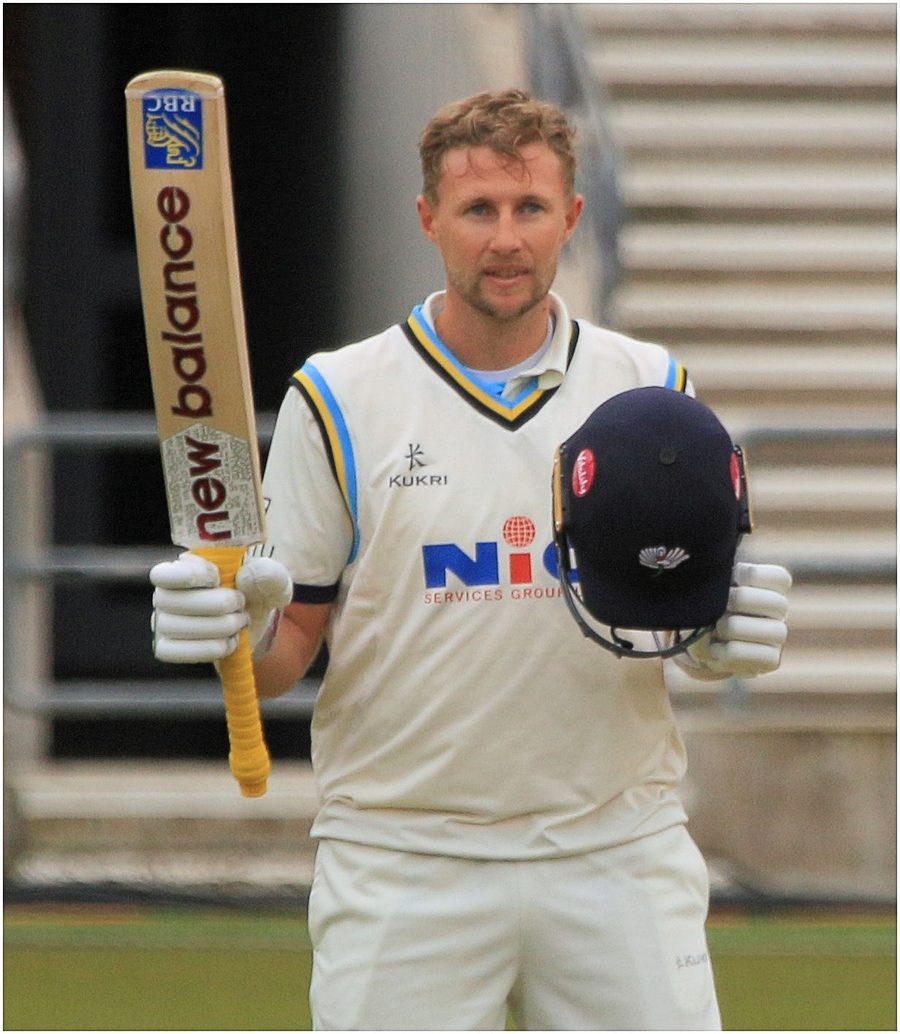
There is a particular sound a Joe Root cover drive makes, and it is quieter than you expect. He does not lean into the ball so much as arrive alongside it, hands soft, bat face closing at the last moment, and the ball leaves the square with placement doing the work that other batters ask of power. It is the signature shot of the most complete England batter of his era, and like everything else in his game it was built in a specific place, by a specific tradition, before anyone outside South Yorkshire had heard his name.
Sheffield Collegiate and the inheritance
Root was born in Sheffield on 30 December 1990 and came through Sheffield Collegiate, the same club that produced Michael Vaughan a generation earlier. The line from Vaughan to Root is more than trivia. Both were slim, technically orthodox top-order batters taught to value the leave, to play the ball under their eyes, and to treat occupation of the crease as the job itself. Root's younger brother Billy came through the same nets; their father played league cricket for years. It is about as traditional an English cricket upbringing as the modern game still produces.
From there the path ran through Worksop College and the Yorkshire academy into a first-class debut in 2010. Yorkshire's dressing room at the time still carried the county's old orthodoxy — bat all day, earn the right, respect the four-day game — and Root absorbed it completely. Anyone wanting the wider context of that system will find it in the guide to the County Championship and the broader survey of cricket in England. What matters here is what it produced: a batter whose defence was Test-ready at twenty, years before his scoring shots caught up.
The set-up, and what changed over the years
Root's stance has never been static. Early in his career he stood relatively still, with a modest back-and-across trigger and a high grip. Over the years the pre-movement grew — a deeper press back into the crease, weight loaded on the back foot — which is what lets him play the ball later than almost anyone. Playing late is the organising principle of his whole method. The drive is checked rather than flowing, the pull is a swivel rather than a swing, and the ball is met under the eyes rather than out in front.
The cost of that lateness was, for a long time, a specific dismissal: caught behind or at slip, pushing at a good-length ball outside off with hands ahead of body. Australian attacks in particular targeted it, and the delivery angled in and straightening accounted for him repeatedly across three Ashes tours. The adjustment he settled on — a slightly more open stance and a stricter leave — never eliminated the dismissal, but it narrowed the corridor bowlers had to hit, and his home record against the moving ball became one of the best of his generation.
The glide, the nudge, and the art of strike rotation
Watch a Root fifty and try to remember the boundaries; you usually cannot. His scoring is built on the run rather than the four: the steer to third man played with an angled face, the tuck off the hip, the punch into the covers for one. He scores on both sides of the wicket to good balls, which is rarer than it sounds, and it means bowlers get no rest against him even when they are bowling well.
The third-man glide deserves its own paragraph because it is the most Root shot of all. Played to balls other batters defend, it turns the best delivery of an over into a single, and it infuriates captains because no field quite legislates for it. It carries risk — the edge is in play by definition — and the calculation Root has made across fifteen years is that the reward compounds. A batter who scores off good balls forces bowlers to try something worse.
How he plays spin, and why Asia became his garden
Root's method against spin is the most transferable part of his game and the reason his overseas record stands apart. It rests on three things. First, the sweep in all its forms — orthodox, paddle, and the hard flat sweep in front of square — played to length rather than to line, which drags spinners off their plan. Second, the use of the crease: he goes very deep to cut and pull anything short, and comes down the pitch mainly to defend, killing spin before it happens. Third, an unusual willingness to score square on the off side against the turning ball, where most visiting batters look only to leg.
The results are a matter of record. Consecutive double-and-near-double innings of 228 and 186 at Galle in January 2021. A ten-hour 218 at Chennai in his hundredth Test. The 262 at Multan in 2024 that stands as his highest score. English batting collapses in Asia are a genre of their own, and Root has spent a decade batting serenely through the middle of them. Only a handful of visiting players — Kane Williamson among them — have solved the subcontinent so thoroughly.
The reverse scoop, learned at 31
Nothing in Root's orthodox upbringing predicted the shot he unveiled against India at Edgbaston in 2022: the reverse scoop off a fast bowler, played to Jasprit Bumrah of all people, flicked over the slips for six in the middle of a match-winning 142 not out. He has since played it against the new ball, against 90mph, and in Ashes Tests, and he practises it with the repetition he once reserved for the forward defensive.
The shot is less reckless than it looks. Root plays it when the field is stacked conventionally, when fine third is up or absent, and when the bowler's length is predictable — conditions under which, by his own accounting, the scoop is a percentage stroke. It arrived with the environment Ben Stokes and Brendon McCullum created, in which risk was reframed as a batting skill to be trained rather than a character flaw to be coached out. That a thirty-something with 10,000 Test runs was willing to add it says more about his appetite than any statistic; the effect on his output is traced in the piece on his pursuit of the all-time run record.
The other skills: slips, off-breaks, and the wicketkeeping he gave up
Root is one of the better slip fielders England have had, particularly standing wide at first slip to spin, where his hands are genuinely elite. He kept wicket as a junior and the residue shows in how late he takes the ball. His off-spin, treated as a joke early in his career, matured into a usable fifth option — good enough for occasional five-wicket hauls and for regular overs in Asia, delivered with a remodelled action after his original one drew scrutiny in 2023 testing.
None of it is incidental. Root's fielding kept him in the side as a package during rare batting troughs, and his bowling has bought England overs of rest for frontline attacks across a hundred-plus Tests. The all-round craft is part of why he has been so nearly ever-present since 2012.
White-ball translation, and the limits of orthodoxy
Root's method translated to the fifty-over game more or less intact: he was the anchor of the side that won the 2019 World Cup, scoring 556 runs in the tournament with two hundreds while strikers hit around him, and his role in the wider white-ball revolution was to be the fixed point the aggression was built on. In Twenty20 the translation was never as clean. He played the 2016 T20 World Cup — including a decisive 83 against South Africa in a record chase — but as the format's power standards rose he fell out of England's short-form plans, went unsold in IPL auctions for years, and made a single brief appearance for Rajasthan Royals in 2023.
That gap is the honest boundary of the Yorkshire method. A game built on lateness, placement and running converts brilliantly to every long format and to fifty overs, and only partially to twenty. Root has never pretended otherwise, which is its own kind of self-knowledge.
What the method amounts to
Strip the numbers away — they live in the record piece — and what remains is a style argument. Root represents the proposition that classical technique, taught patiently through a county system in the English domestic structure, can still produce the best batter in the world; that a player can add a reverse scoop at 31 without dismantling a forward defensive learned at 11. Among England's greatest Test players he is the one whose game a coach would put on a training-ground screen, shot by shot, and say: this is how it is supposed to look.