

Joe Root's Test Run Record and the Chase of Tendulkar
Joe RootEngland
By CricketTaken EditorialPublished Player analysis7 min read
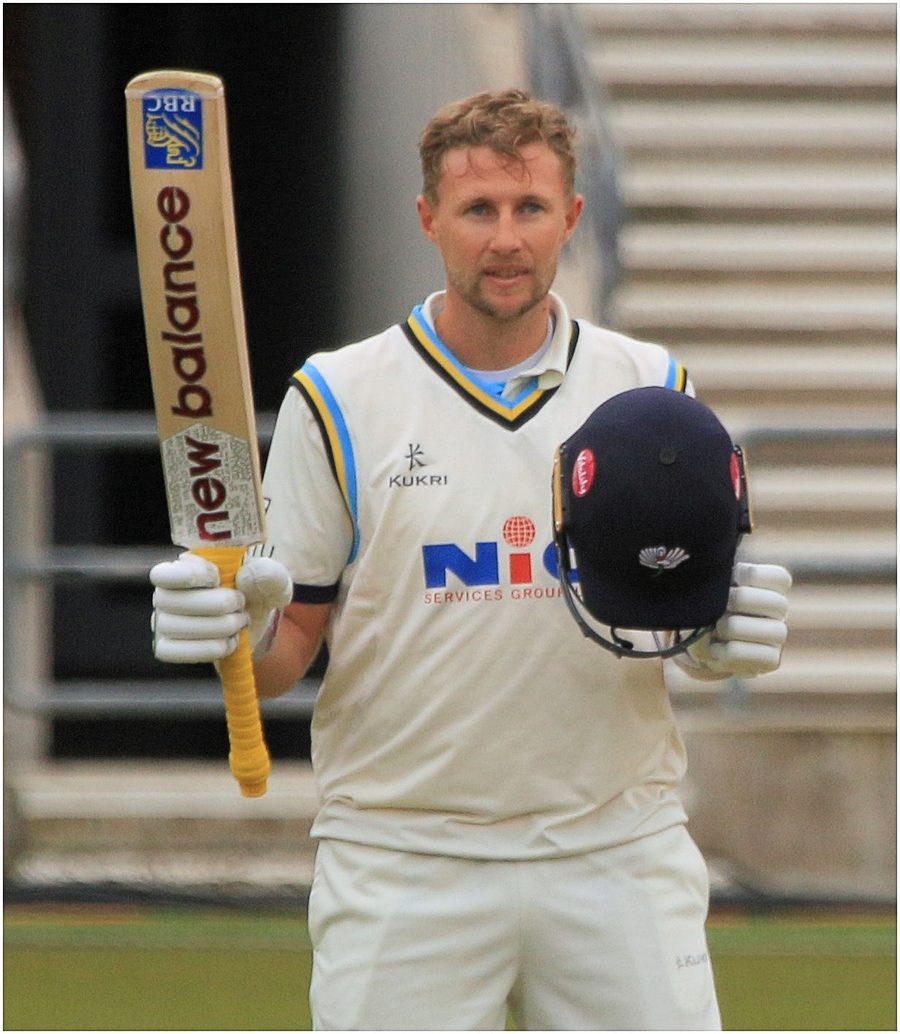
Only one man has scored more Test runs than Joe Root, and he retired in 2013. That sentence would have sounded absurd for most of Root's career, because for most of it the conversation was about what he had failed to do rather than what he had done. He was the England batter who got to fifty and got out, the one of the so-called big four with the fewest hundreds, the stylist whose average sat a rung below Smith, Kohli and Williamson. Then, from 2021 onwards, he simply out-scored everyone, year after year, until the only names above him on the all-time list began disappearing one by one.
A debut at Nagpur and a decade of accumulation
Joe Root made his Test debut in December 2012 at Nagpur, in the final match of the series England won in India, and batted for nearly five hours for 73. It was an old-fashioned innings on a dead pitch, played by a slight 21-year-old Yorkshireman who had been picked partly on the strength of a strong Lions tour and partly because Nick Compton's opening partner needed cover. Nothing about it suggested urgency. Everything about it suggested permanence.
The first hundred came within six months, 104 against New Zealand at Headingley in May 2013, and from there the accumulation was relentless without ever being spectacular. Root passed 1,000 Test runs in his first full year. By the end of 2015 he was established at number four; by the end of 2016 he had more than 4,000 runs and a Test average in the low fifties. He was dropped exactly once, for the Sydney Test of the 2013-14 Ashes, a whitewash that ended several England careers. It remains the only Test England have left him out of since.
What set the record on its eventual course was volume of opportunity as much as talent. England play more Test cricket than anyone else, and Root almost never misses any of it. He has repeatedly played through England years of fourteen or fifteen Tests, an itinerary no other country schedules, and he has stayed fit through virtually all of them. Longevity of that kind is a skill in itself, and it is the quietest part of his record.
The conversion problem, stated honestly
Between 2017 and 2020 Root had a specific, measurable flaw, and it defined how he was discussed. He kept scoring fifties and kept failing to turn them into hundreds. At the low point the ledger read roughly two half-centuries for every one he converted, a ratio far worse than the other leading batters of his generation, and the pattern was consistent enough that it could not be dismissed as luck. He was getting in, doing the hard part, and getting out between 50 and 99.
The years in question were also his captaincy years, which is not a coincidence anyone has managed to disprove. The full story of that period is told in the piece on his time as England captain, but the batting summary is simple: he remained England's best player throughout while operating a clear notch below his own ceiling. His average drifted from the mid-fifties towards the high forties. For most batters that would be a career. For Root it read as underachievement.
2021, the year the ledger turned
Then came 2021, statistically the best calendar year any England batter has had. Root scored 1,708 Test runs in it, the third-highest total ever recorded in a calendar year, behind only Mohammad Yousuf's 1,788 in 2006 and Viv Richards' 1,710 in 1976. He began it with 228 and 186 in consecutive Tests at Galle, added 218 against India at Chennai in his hundredth Test, and then carried a collapsing England batting order through a home summer against India and an away Ashes almost single-handedly.
The strange thing about 1,708 is that England kept losing. Root's six hundreds that year came in a side that won four Tests and lost nine, and none of the six came in a victory. It is the clearest case in the modern game of an individual season detached from its team's results, and it settled the conversion argument for good. The fifties were becoming hundreds; the hundreds were becoming big ones; only the team had not improved.
What the relief of 2022 did for the average
When Root gave up the captaincy in April 2022, the popular prediction was a gentle decline into the senior-pro role. The opposite happened. Freed of the job and batting in the more aggressive side Ben Stokes and Brendon McCullum built, Root produced the most fluent cricket of his life. He scored quicker, reverse-scooped seamers for six, and kept converting. His average, which had sagged below fifty during the captaincy, climbed back above it and stayed there.
The stylistic change is worth separating from the numbers. Root under Stokes did not become a slogger; he became a batter who cashed in faster once set, which is precisely what the conversion problem had denied him. A fuller account of the technique underneath it all sits in the companion piece on the Yorkshire method. The output is what concerns us here: from mid-2022 onwards Root stacked hundreds at a rate he had never previously touched, including a 262 at Multan in October 2024, his highest Test score, made during a stand of 454 with Harry Brook.
Passing Cook, then passing everyone else
The records began falling in sequence. In August 2024, against Sri Lanka at Lord's, Root went past Alastair Cook's England record of 12,472 Test runs, a mark that had been expected to stand for a generation when Cook retired in 2018. Cook had needed 161 Tests; Root reached the figure noticeably faster, and he was still nowhere near finished.
Eleven months later came the innings that reframed the whole discussion. At Old Trafford in July 2025, against India, Root moved past Rahul Dravid, Jacques Kallis and Ricky Ponting in the course of a single hundred, climbing from fifth to second on the all-time Test run list in one afternoon. Only Sachin Tendulkar, with 15,921 runs from 200 Tests, remained above him.
| Batter | Tests | Runs |
|---|---|---|
| Sachin Tendulkar | 200 | 15,921 |
| Joe Root | — | second, still adding |
| Ricky Ponting | 168 | 13,378 |
| Jacques Kallis | 166 | 13,289 |
| Rahul Dravid | 164 | 13,288 |
The gap to Tendulkar is the last question left, and it is a question about time rather than ability. Root turned 35 at the end of 2025. England's schedule offers him more Tests per year than Tendulkar ever had, and his fitness record is close to unblemished. Whether the record falls depends on how long he chooses to keep doing this, not on whether he is good enough.
The one blank space, and the fairest reading of it
No account of the record is honest without the asterisk that followed him for a decade: through his first three tours there, Root had never scored a Test hundred in Australia. The 2013-14, 2017-18 and 2021-22 Ashes trips produced fifties in quantity and a highest score in the eighties, and Australians brought it up roughly as often as Englishmen brought up Tendulkar. It was the single sustained gap in a record otherwise spread evenly across conditions — he has big hundreds in Asia, in the Caribbean, at home, and against every kind of attack.
Set against that is a subcontinental record almost no visiting batter can match. Root averages comfortably more in Asia than most great players manage at home, built on the sweep, the use of the crease and a method against spin covered in detail elsewhere. The World Test Championship era has only sharpened the contrast: England's cycles have foundered on results in Australia and India, the two places a touring batter's record is judged, and Root's own numbers in the second of them are beyond argument.
Where the record sits in England's history
England have produced heavier scorers relative to their era — Hobbs and Hammond dominate the pre-war ledgers, and Cook's endurance as an opener bears no comparison with life at four — but no England batter has ever held the national side's batting together for as long as Root has, through as many rebuilds. He has outlasted four permanent captains, two complete overhauls of the top order, and the entire arc of a white-ball revolution in which he also happened to play a 2019 World Cup as England's leading run-scorer.
The wider context is set out in the history of England cricket, and the club that shaped him is covered in the guide to cricket in England; the short version is that the county system's most reliable product turned out to be its best one. Root came through at Yorkshire in the County Championship, was picked young, and never went away.
Whether he catches Tendulkar is, in the end, the least interesting thing about the chase. The interesting thing is that the question is being asked seriously at all — about the batter who, five years into his captaincy, was routinely ranked fourth among the four best players of his generation. The other three have finished. Root is still batting.