

Mohammed Shami's Test Bowling: Seam, Wrist and Reverse Swing
Mohammed ShamiIndia
By CricketTaken EditorialPublished Player analysis9 min read
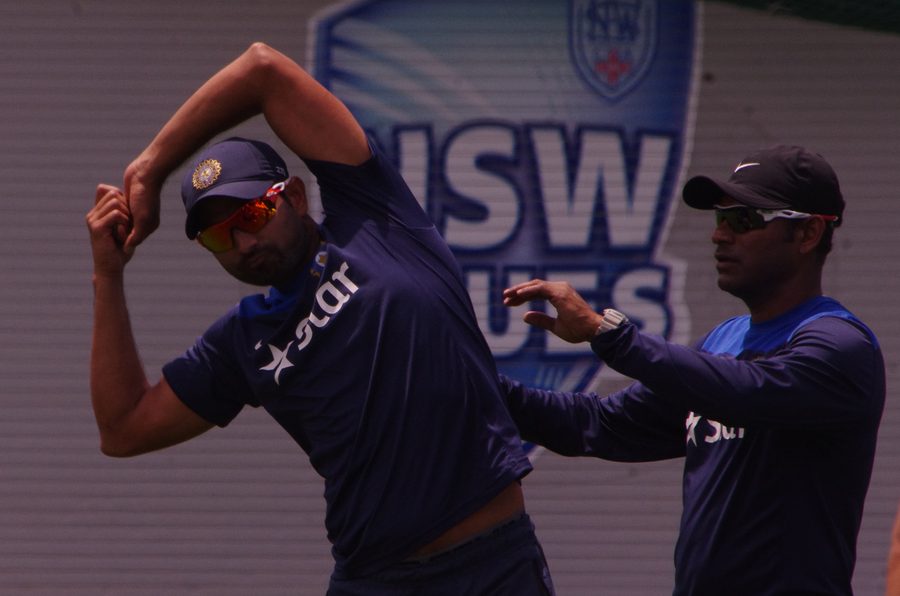
Ask a batter who has faced Mohammed Shami in a Test match what makes him difficult and the answer is rarely about pace. He operates in the mid-140s at his best, quick but not exceptional, and he has no obvious trick: no extreme angle, no slingy release, no delivery held back out of the hand. What he has is a seam that arrives at the batter standing bolt upright, over after over, whatever the state of the ball. Everything else in his Test record follows from that single mechanical fact.
Nine wickets on debut, and where they came from
Shami's first Test came at Eden Gardens in November 2013, against West Indies, in the series staged as Sachin Tendulkar's farewell. He took nine wickets in the match, the best return by an India bowler on Test debut for decades, and the way he took them told the story of the career to come. The pitch offered little conventional movement. The ball was old for most of both innings. Shami attacked the stumps at a full length and let the scrambled surface do the work, finding reverse swing when the Kolkata square had given the other seamers nothing.
He had reached that point by an odd route. There was no age-group pedigree, no junior India cap, no academy production line behind him. He had moved from rural Uttar Pradesh to Kolkata as a teenager purely to find organised cricket, worked through the club system, and forced his way into the Bengal side on wickets taken rather than reputation. When he arrived in the Test team he was already twenty-three, with a first-class education built almost entirely on unresponsive eastern-India pitches. Bowlers raised on surfaces like those learn to beat the bat off the pitch or they do not survive, and Shami survived.
The wrist behind the ball
The mechanics are worth describing precisely, because they are the whole method. At the point of release Shami's wrist sits directly behind the ball, fingers either side of the seam, and the ball leaves his hand rotating backwards along the seam's own axis. The result is a delivery that travels with the seam vertical and stable, like a gyroscope, rather than wobbling or rolling sideways.
Two consequences follow. First, when the ball lands it lands on the seam, which maximises the chance of lateral deviation off the pitch in either direction. Batters cannot line him up because the movement is decided by the surface at the moment of contact, not signalled in the air. Second, the upright seam preserves the ball's condition asymmetry, which means a ball that is swinging keeps swinging longer in his hand than in most others. Coaches at every level teach this presentation; almost nobody maintains it deep into a spell, at full intensity, on the third day of a Test. Shami's repeatability is the skill, not the position itself.
Compare him with his contemporaries and the differences are sharp. Jasprit Bumrah generates his threat from an unrepeatable action and late movement at high pace. Bhuvneshwar Kumar is a conventional swing bowler who needs the ball to be new or the air to be heavy. Shami is neither. His stock ball is the same in Nagpur and Johannesburg, and its threat scales with how abrasive the surface is, which is why his best days so often came abroad.
Reverse swing, and why the old ball belonged to him
Reverse swing rewards exactly the qualities Shami has. It requires a ball with one rough side and one maintained side, delivered at genuine pace, full, with a stable seam. A wobbling seam kills reverse; an upright one protects it. From about the fortieth over of an innings, when most attacks are containing and waiting for the second new ball, Shami became India's principal wicket-taking option, targeting the stumps and the pads with a ball ducking in late.
The numbers behind this are a pattern rather than a single figure: across his career a striking share of his Test wickets were bowled or leg-before, a proportion well above the norm for fast bowlers of his era. That is the signature of a bowler whose plan is the stumps. Slip catches depend on the batter's error; bowled and lbw depend only on the delivery. It also made him unusually independent of his fielders and his captain's funkier field settings. The great reverse-swing bowlers of the Pakistani tradition worked the same way, and the history of reverse swing is essentially a history of bowlers who attacked the stumps with an old ball. Shami is India's clearest inheritor of that lineage.
The knee, the surgery and the missing seasons
The cost of the method was carried by his body. Shami bowled through the 2015 World Cup on a damaged knee, managing the pain between matches, and went in for surgery when the tournament ended. The rehabilitation removed him from Test cricket for the best part of eighteen months, through home series he would have dominated, and when he returned in 2016 there were legitimate doubts about whether the pace and the snap in the action would return with him.
They did, but slowly, and the years from 2015 to 2017 are the quiet middle of his record. Fitness became the recurring criticism: he was in and out of sides, occasionally underprepared, and the gap between his best spells and his ordinary ones widened. What changed was a deliberate rebuilding of his conditioning in 2017 and 2018, undertaken alongside the fitness culture then being enforced across the team under Virat Kohli. The bowler who emerged from that period was heavier through the shoulders, held his pace deeper into spells, and was about to produce the best three years of his career, almost all of it away from home.
Johannesburg 2018, and the overseas case
India's 2018 tour of South Africa was lost 2-1, but the third Test at the Wanderers was won on the most spiteful pitch of the series, and Shami's second-innings five-wicket haul finished it. On a surface where the ball leapt and seamed at inconsistent heights, the bowler who hit the seam most often was the most dangerous, and that was him. It began a stretch in which his overseas record stopped being a promise and became a fact.
In England later that year he was part of an attack that repeatedly dismantled the home top order even as India lost the series, sharing the load with Ishant Sharma and Bumrah while James Anderson did the same from the other end. Then Australia, 2018-19: India's first Test series win in that country, sealed 2-1, with the pace attack taking the bulk of the wickets. Shami's return there was second only to Bumrah's among the quicks, and his role was specific. Bumrah attacked with the new ball; Shami broke partnerships in the long middle sessions when the Kookaburra had gone soft, which on Australian grounds is where series are actually decided. That winter the trio of Shami, Bumrah and Ishant Sharma, with Umesh Yadav rotating in at home, took wickets at a rate no previous generation of Indian seamers had approached in a calendar year.
He kept adding to the case. At Centurion in December 2021 he took a five-wicket haul in a Test India won, and in the course of it became the fifth India fast bowler to reach 200 Test wickets, at a strike rate quicker than any of the four before him. For a country whose bowling identity was built on spin, that list is short and recent, and Shami's place on it rests almost entirely on wickets that had to be extracted rather than gifted.
Lord's, and the batting nobody planned for
The 2021 tour of England produced the strangest entry in his record. At Lord's, with India eight down and barely ahead on the final morning, Shami and Bumrah put on an unbroken ninth-wicket stand of nearly ninety, Shami reaching an unbeaten Test fifty with a straight-driving calm that no bowling all-rounder in the side could match that day. The stand turned a likely defeat into a declaration, and England were then bowled out in the evening session for a 151-run win. It remains the only sustained batting contribution of his Test career, which makes it more revealing, not less: under the least pressure of expectation, the hand-eye ability that underpins his bowling repeatability was suddenly visible with a bat.
That match sat inside the second World Test Championship cycle, and the WTC era frames his late career. He played in the inaugural final against New Zealand in Southampton, where Trent Boult and the home-style conditions favoured the winners, and again in the 2023 final against Australia at The Oval, which India also lost. Both defeats followed the same shape: India's attack competitive, India's batting short of a match-defining innings. Neither final is a mark against the bowlers, but neither gave Shami the medal his red-ball work had earned.
The attack he anchored, and the one that followed
For roughly five years India fielded the deepest pace attack in its history, and Shami was its fulcrum rather than its spearhead. Bumrah took the new ball and the headlines. Ishant provided bounce and angle. Umesh was the enforcer at home, and later Mohammed Siraj added a wobble-seam variation Shami never used. Within that group Shami's job was the hardest to see and the hardest to replace: overs thirty to seventy, old ball, flat periods, keeping the game moving when nothing was happening. Attacks are usually remembered by their opening pair. This one worked because of its middle.
The home record deserves a word too, because it is routinely misread. On turning Indian pitches Shami's overs were few, but they were seldom idle: his role in home wins was to remove the set batter the spinners could not, usually with reverse swing in a three-over burst either side of tea. Series in India during those years were reported as spin triumphs, and mostly were, yet the scorecards keep showing a Shami intervention at the moment a partnership threatened to matter. Bowlers who do that job well make their team-mates' averages better and their own workload invisible.
An ankle problem after the 2023 season required surgery and took more than a year out of his career, and his eventual return came in white-ball cricket rather than Tests. Whatever the final aggregate ends up being, the shape of the red-ball record is settled: a bowler who was better abroad than at home, better with the old ball than the new, and better than his raw totals suggest because so much of his work created wickets credited to others.
Where the method leaves him
Judged against the long line of Indian seamers, from the workhorses of the 1980s through Srinath and Zaheer Khan, Shami's distinction is that he required nothing from the conditions. Swing bowlers need cloud, hit-the-deck bowlers need bounce; a seam-presentation bowler needs only a pitch, and every match has one. That is why his Test bowling travelled, and why anyone reading the history of Indian cricket through its fast bowlers will find him at the point where India stopped picking seamers for home conditions and started exporting them. The fuller account of his one-day tournaments is a separate story, told in his World Cup record, and his franchise career took a different path again. The Test bowling is the purest version of him: one repeatable action, one upright seam, and a decade of batters beaten off the pitch.