

Imran Tahir Started at 32 and Peaked at 40
Imran TahirSouth Africa
By CricketTaken EditorialPublished Player analysis7 min read
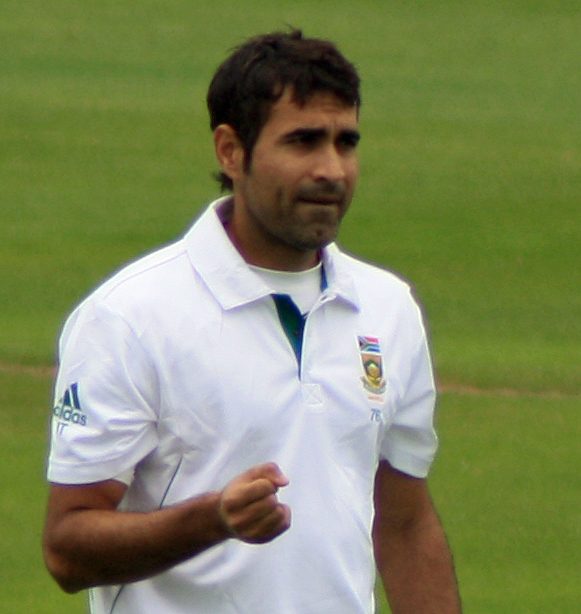
Most cricketers do their best work between twenty-four and thirty. Imran Tahir made his international debut at thirty-two and produced the finest season of his career at forty, when he took 26 wickets to win the Indian Premier League's Purple Cap — the most wickets any spinner has taken in a single edition of the tournament, and the oldest a bowler has been while topping the charts.
The interesting claim about Tahir is not that he was a late bloomer. It is that his career ran in the wrong direction entirely: the years he lost were the ones a leg-spinner is normally supposed to spend learning the trade, and he spent them instead bowling in county and club cricket at a standard well below his own, waiting for a nationality. By the time anybody let him bowl at a Test batter he was a finished product with a decade of match craft and no international mileage on his body at all. That combination, unusual to the point of being unique, explains both halves of what followed.
Ten years of waiting
He was born in Lahore in March 1979 and came up through Pakistan's system without breaking into the national side. What happened next is a long and slightly absurd itinerary: Tahir played professionally in England, in South Africa, and anywhere else that would have him, and became a South African citizen through marriage. Qualification rules meant he could not represent his adopted country immediately, and so a bowler in the prime years of his life piled up first-class wickets in competitions nobody was watching.
The waiting had one useful side effect. A leg-spinner needs volume — thousands of deliveries of trial and error before the googly is reliable and the field settings make sense — and Tahir got all of it in low-stakes cricket. When South Africa finally picked him for the 2011 World Cup, against West Indies, he was thirty-two years old and immediately good. Countries do not usually get a fully formed spinner on debut.
The Test career, and the honest limit
South Africa had lacked a top-class spinner for years, and Tahir was the answer for a while. He played twenty Tests and took wickets, but the red-ball record is the weakest part of his career and pretending otherwise would be dishonest: Test batters had time to work him out, his economy suffered on flat surfaces, and a difficult tour of Australia in 2012 — where he was hit for a large number of runs in a single innings at Adelaide — effectively ended him as a first-choice Test selection.
The limited-overs record is a different document. He finished as one of South Africa's leading one-day wicket-takers and spent long spells rated among the best short-format bowlers in the world, at a point in life when most spinners are coaching. He also became one of the most recognisable celebrators in the game, sprinting the length of the ground after wickets with an enthusiasm that read, entirely accurately, as a man who had waited a long time to be allowed to do this.
Why the IPL suited him better than Test cricket
Twenty20 rewarded exactly what Test cricket had exposed. A leg-spinner who turns the ball both ways and attacks the stumps is expensive if a batter can wait him out for two hours; if the batter has to score at eight an over, the same bowler becomes the hardest problem on the field.
His IPL career record, computed from the open ball-by-ball archive, makes the point without argument: 59 matches, 1,316 deliveries, 82 wickets, an economy rate of 7.76 and a bowling average of 20.77. Among every bowler who has taken at least fifty wickets in the competition's history, only Lasith Malinga has a better average. No spinner is close. His strike rate of one wicket every sixteen balls is in the same territory as Kagiso Rabada and Andre Russell, which is not company a wrist-spinner in his late thirties should be keeping.
The phase split shows how he was used and why it worked. He bowled 941 of his deliveries in the middle overs and took 54 wickets there at 7.21 an over — the classic assignment for an attacking spinner, handed the seventh to fifteenth overs and told to take the game away rather than hold it still. He was also trusted at the death more than most spinners: 321 deliveries in the last five overs for 25 wickets, striking every 12.8 balls. Twenty-eight of his 82 dismissals were bowled, leg before or stumped, which is a high proportion and tells you he was beating the bat rather than waiting for mishits.
The 2019 season
The 2019 tournament is the peak, and the numbers deserve laying out. Seventeen matches, 386 deliveries, 26 wickets, an economy rate of 6.70 and an average of 16.58 — the leading wicket tally of the season, taken from Rabada with two wickets in the final itself. He was forty years old. No spinner has taken more in a single IPL season, and no bowler of that age has topped the charts before or since.
It was also, by a distance, the most economical high-volume season of his franchise career. In a competition where a good spinner concedes seven and a half, he went at 6.70 across seventeen matches. Two performances stand out from that year: three for nine against Royal Challengers Bangalore at Chepauk in March, and four for twelve against Delhi in a twenty-ball spell in May. Chennai Super Kings reached the final and lost it narrowly to Mumbai, and the Purple Cap was a small consolation for a side that had built its whole season on spin.
His four seasons at Chennai produced 35 wickets in 27 matches at an economy of 7.11, the best team split of his career, and the fit was obvious. The Chepauk surfaces suited him, MS Dhoni set fields for a wicket-taking spinner rather than a containing one, and a franchise with a long-standing preference for experienced professionals over young talent had no problem at all with a bowler in his forties.
Before Chennai, and after
The earlier part of his IPL career was less settled. He took 29 wickets in twenty matches for Delhi across 2014 to 2016 at a considerably worse economy of 8.61, on grounds and in a side that gave him less protection, and had one strong year at Rising Pune Supergiant in 2017 — eighteen wickets in twelve matches at 20.50 — which was the season that earned him the Chennai contract when the franchise returned.
After 2019 the appearances thinned out. Three matches in the 2020 tournament in the United Arab Emirates and one in 2021 closed the account. A leg-spinner past forty is a diminishing asset even when he was the best in the league eighteen months earlier, and Chennai, having got the peak, moved on.
The argument
Tahir's career is the strongest available evidence that a spinner's prime is not where the age curve says it should be. He lost the decade in which most bowlers of his type are supposed to develop, and it cost him almost nothing in white-ball cricket, because the skills that decide short-format spin bowling — control of the googly, reading a batter's intent, knowing which ball to bowl to a left-hander with three overs left — are learned rather than physical, and because a bowler who has not spent ten years bowling forty overs a day in Test cricket has a body that lasts.
What it did cost him was the Test career. Twenty matches is what happens when you arrive at thirty-two: not enough time to learn the format's specific patience, and no margin for the bad tour that would have been forgiven in a twenty-five-year-old. Anyone reading his franchise record alongside the Test one is looking at two different bowlers, and the difference between them is not skill but the length of time the game gave him to use it.
Sources and method
The biographical material — the Lahore birth, the years in county and club cricket, the citizenship through marriage, the 2011 World Cup debut and the Adelaide innings — is descriptive, drawn from published records and contemporary reporting. His Test and one-day appearance figures are published career records. The IPL match, wicket, economy, average, strike-rate, phase and dismissal-type figures were computed from the open ball-by-ball archive, which covers every IPL season to date; phase splits use overs 1-6, 7-15 and 16-20. The comparison of career bowling averages is restricted to bowlers with at least fifty IPL wickets and was computed over the same archive, so it reflects the league only and not other competitions.