

Virender Sehwag's ODI Record and the 219 at Indore
Virender SehwagIndia
By CricketTaken EditorialPublished Player analysis7 min read
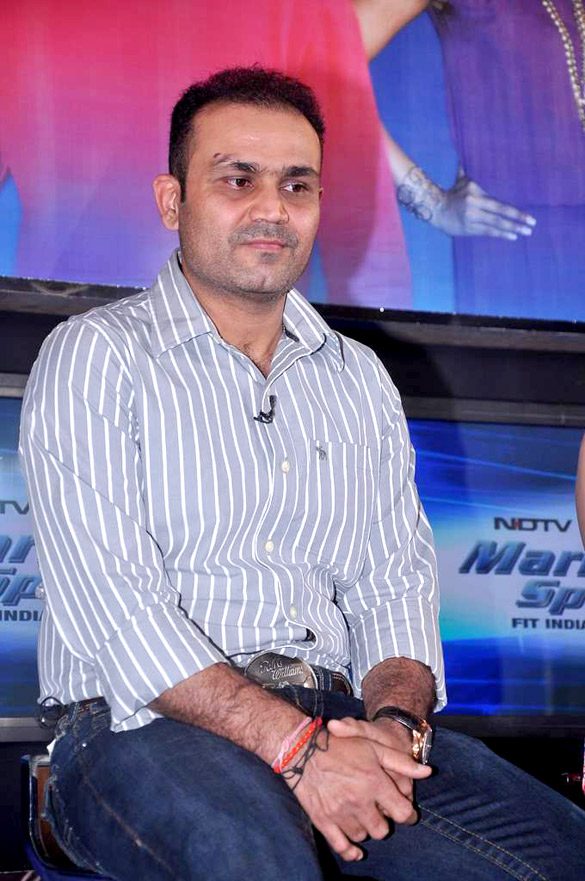
On 8 December 2011, at the Holkar Stadium in Indore, Virender Sehwag made 219 against West Indies from 149 balls, with 25 fours and seven sixes. It was at that moment the highest score in the history of one-day international cricket, and he was captaining India that day, standing in for a rested MS Dhoni. India made 418 for 5 and won by 153 runs. Only one man had ever reached 200 in the format before, and he was Sehwag's opening partner.
The innings was the largest single expression of a career-long position: that a fifty-over innings is three hundred deliveries of attacking opportunity, and that an opener who declines the opportunity is wasting the fielding restrictions. Sehwag finished with more than 8,000 one-day runs at a strike rate above 104. When he started, no opener with a substantial career had scored that fast. By the time he finished, the whole format was moving his way.
A debut in 1999, and a slow beginning
His one-day debut came against Pakistan at Mohali in April 1999, as a twenty-year-old off-spinning all-rounder from Najafgarh in Delhi. It went badly, he was dropped, and he did not get a sustained run in the side until late 2000. The early one-day career, in other words, predates the detailed ball-by-ball archives, and the honest summary of it is that India were not yet sure what they had. He batted in the middle order, bowled a few overs, and looked like one more contender for the endless procession of number sixes.
The first unmistakable signal was a rapid maiden hundred against New Zealand in Colombo in 2001, batting up the order. The selectors and Sourav Ganguly, then captain, drew the obvious conclusion. A batter who hit like that needed to face as many balls as possible, and the place to arrange that was the top of the innings.
Opening with Tendulkar and Ganguly
For the first years of the 2000s India's one-day batting began with some combination of Sehwag, Sachin Tendulkar and Ganguly, which obliged opposition captains to solve an unpleasant puzzle: two of the three would open, all three scored hundreds, and none of them played the new ball respectfully. Sehwag was the junior partner and the least orthodox. Tendulkar and Ganguly had built their records on judgement and placement. Sehwag simply hit the first half-volley for four regardless of what over it arrived in, and his partnership with Tendulkar in particular became one of the defining sights of the era, the master and the apprentice who had copied the strokes but not the caution.
The arrangement carried India through the 2003 World Cup in southern Africa, where they won eight matches in a row on the way to the final. The final itself was a mismatch. Australia made 359 for 2 and India's chase collapsed early, with one exception: Sehwag's 82, the top score in the innings, made while wickets fell steadily at the other end. It was his first World Cup, and the innings is largely forgotten because the match was gone before it ended. He had also been part of the side that shared the 2002 Champions Trophy with Sri Lanka after a washed-out final in Colombo, an early entry in a career oddly full of trophies decided by circumstance.
The 219, and what it displaced
Tendulkar had made the format's first double hundred in February 2010, unbeaten against South Africa at Gwalior. Sehwag's 219 at Indore, twenty-two months later, went past it and kept going, and the manner of it was characteristic. There was no acceleration phase, because there was no accumulation phase to accelerate from. He reached his hundred inside the first twenty-five overs, put on a large opening stand with Gautam Gambhir, and treated the West Indies spinners with particular severity on a small, quick-scoring ground.
Two details give the innings its texture. First, it was his final one-day hundred, scored in the last full year of his international career, by a batter whose reflexes were already going in the longest format. Second, it made him at the time one of only two men with an ODI double hundred, both of them Indian openers, both past thirty-five when they did it. The record stood for just under three years before Rohit Sharma's 264 at Eden Gardens took it somewhere nobody has followed. Sehwag's remains among the highest one-day scores ever made, and it was compiled faster than most of the innings above and around it on that list.
The 2011 World Cup, and a first ball hit for four
The 2011 World Cup, played at home, was the peak of the one-day side Sehwag belonged to. He announced it in the opening match at Mirpur, making 175 against Bangladesh in a total of 370 for 4, the highest score of his World Cup career, in an innings that settled a match carrying four years of accumulated grievance. Through the tournament he developed a habit that became its own running joke: the first ball of the Indian innings, whoever bowled it, tended to disappear through the off side for four.
His semi-final contribution against Pakistan at Mohali was brief and violent, five boundaries in a single over from Umar Gul in the powerplay, and in the final at the Wankhede he was out for nought off the second ball of the chase. That is the full range of Sehwag in two matches. India recovered through Gambhir's 97 and Dhoni's unbeaten 91 to win their first World Cup since 1983, with Yuvraj Singh named player of the tournament and Zaheer Khan finishing as the joint-leading wicket-taker. Sehwag's aggregate was front-loaded into the early rounds, which is roughly the story of his one-day career in miniature: the damage happened early, and others finished.
2007: the worst tournament and the best one
Four years earlier the same generation had produced the lowest moment in India's modern one-day history. At the 2007 World Cup in the Caribbean, India lost their opening match to Bangladesh, beat only Bermuda, a match in which Sehwag made 114, and were eliminated in the group stage inside a fortnight. He had gone into the tournament in poor form and came out of it with his place in genuine doubt for the first time since 2001. The inquest reshaped Indian cricket's relationship with the fifty-over game.
The recovery began in the format nobody yet took seriously. At the first World Twenty20 in South Africa that September, a young Indian side without several senior players won the tournament, beating Pakistan in the final at Johannesburg. Sehwag opened the batting through the campaign but injured himself before the final and watched it from the dressing room, an oddly Sehwag-like way to be part of a triumph. Between the 2007 collapse and the 2011 coronation, that title did more than anything to convince the Indian cricket public that the white-ball future belonged to attackers.
The strike-rate philosophy
Sehwag talked about batting more plainly than almost anyone who has done it at his level. See ball, hit ball was the caricature, and he was happy to endorse it, but the underlying position was considered. He believed the percentages favoured the attacking shot because bowlers under pressure bowl worse, that a dot ball was a small defeat, and that the fear of getting out was a heavier tax on scoring than getting out itself. He sang to himself between deliveries to keep his mind off the match situation, which sounds like an affectation and was actually a method: the situation, in his view, was precisely the thing a batter should ignore.
The one-day numbers are the argument for the philosophy. A strike rate above 104, sustained across more than a decade as an opener, was without precedent when he retired from the format after his last one-day international at the start of 2013. His average, in the mid-thirties, was ordinary, and he would have regarded the trade as obviously correct. Fifteen hundreds, most of them scored at speeds that took the match away from the opposition inside thirty overs, were worth more to the side than a higher average built on slower ones.
Where the one-day record stands
The measurable legacy is the double hundred and the World Cup medal. The larger legacy is the template. Every one-day side now opens with at least one batter given explicit licence to attack the new ball, and the analytics that justify it say what Sehwag said first, without a laptop. He was the extreme case that proved the approach could carry a full career rather than a cameo.
His Test batting, the two triple centuries and the fastest 300 ever scored, is covered in the survey of his Test record. The Twenty20 franchise years with Delhi and Punjab, including a playoff hundred against Chennai that nearly won a title, are in his IPL record. The one-day career sits between those two stories and belongs with both, because it was the same innings every time, played at whatever length the fixture list allowed.